
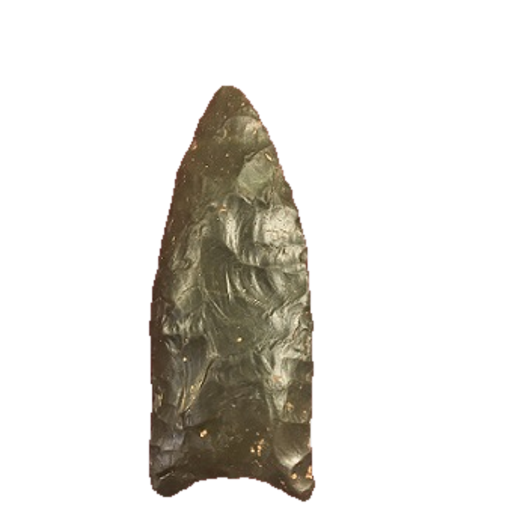
Arrowhead type
Clovis Un-Fluted Point
Clovis Un-FlutedClovis Cluster15,000 - 10,000 B.P.Paleo3 reference photos
Key facts
- Age
- 15,000 - 10,000 B.P.
- Cultural period
- Paleo
- Size
- Small to Medium to Large
- Shape
- Auriculate to Lanceolate
- Material
- Agate
- Glacial period
- Late Pleistocene
More from the Paleo period
Description
This triangular point exhibits a distinctive auriculate form, scaling in size from small to large, with a fluted profile that imparts a flattened cross-sectional appearance. The blade's curvature transitions from an outward recurvate to an excurvate shape, lending it a unique silhouette. The base of the point displays variability, ranging from a classic auriculate shape to forms that are either expanding or contracting, which can evoke the appearance of an articulated or lanceolate point. A notable characteristic of the base is its concave morphology. Although this point type is not defined by the presence of fluting, it may feature basal thinning and evidence of grinding in the hafting region. The flaking pattern on these points can be diverse, encompassing random, collateral, or transverse flaking techniques.
Size
Dimensional Range: The length of the arrowheads spans from 45 mm to 150 mm, while the width ranges from 20 mm to 45 mm, exhibiting significant variability in size.
Distribution
This type has the densest populations across the Ohio, Tennessee, and Mississippi River valleys and the eastern part of the US (red). Numbers decrease in the Grasslands of areas in the US and Canada (dark pink). Clovis points are seldom discovered west of the Continental Divide and into the Polar region of Canada and Alaska (light pink). This type is not documented in the coastal areas of Alaska and Canada possibly due to the sea levels at the time This type is not documented in the glacial regions of the Canadian interior
Mainly found in
- Alabama
- Arizona
- Arkansas
- California
- Colorado
- Connecticut
- Delaware
- Florida
- Georgia
- Idaho
- Illinois
- Indiana
- Iowa
- Kansas
- Kentucky
- Louisiana
- Maine
- Maryland
- Massachusetts
- Michigan
- Minnesota
- Mississippi
- Missouri
- Montana
- Nebraska
- Nevada
- New Hampshire
- New Jersey
- New Mexico
- New York
- North Carolina
- North Dakota
- Ohio
- Oklahoma
- Oregon
- Pennsylvania
- Rhode Island
- South Carolina
- South Dakota
- Tennessee
- Texas
- Utah
- Vermont
- Virginia
- Washington
- West Virginia
- Wisconsin
- Wyoming
- Alaska
- Canada
- Mexico
Additional information
In the realm of Native American arrowheads, the point in question can be challenging to differentiate from other similar types, such as the Plainview points, due to its auriculate and unfluted characteristics. However, one distinctive feature that aids in its identification is the presence of fluted Clovis points, which serves as a key distinguishing factor. This point is considered a rare type, making it a significant find for archaeologists and collectors alike. Its uniqueness is likely due to its specific cultural and historical context, which sets it apart from more common point types.
The rarity of this point type underscores the importance of careful examination and analysis in archaeological identification. The presence of fluted Clovis points, in particular, provides a crucial clue in distinguishing this point from others, such as the Plainview points. By studying the characteristics of this point, researchers can gain valuable insights into the technological and cultural developments of the Native American groups that created it. Furthermore, the point's auriculate and unfluted features suggest a specific functional or stylistic purpose, which may be related to the cultural and historical context in which it was produced.
The identification and study of this rare point type contribute to a deeper understanding of Native American archaeology and the diversity of point types that exist. By recognizing the distinctive features of this point, including its relationship to fluted Clovis points, researchers can refine their understanding of the cultural and historical landscape of the region and period in which it was created. This, in turn, can inform a more nuanced appreciation of the technological, social, and cultural developments of Native American groups, highlighting the significance of continued archaeological research and discovery.
Identified by
- Named by
- Edgar B. Howard
- Year
- 1935
- Type site
- Clovis Site, Blackwater Draw Locality, Curry County, New Mexico
Similar types
Types that are easy to confuse with the Clovis Un-Fluted point.
- Agate Basin
- Angostura
- Alder
- Barber
- Bat Cave
- Belen
- Black Rock
- Barnes
- Beaver Lake
- Browns Valley
- Chipola
- Conerly
- Copena Articulated
- Crowfield
- Cumberland
- Dalton
- Golondrina
- Fayette
- Folsom
- Fredrick
- Lovell
- Midland
- Northumberland
- Red Stone
- Simpson
- Suwannee
- Union
- Withlacoochee
- Wheeler
Other types in the Clovis Cluster
- Anzick
- Clovis Colby
- Clovis Hazel
- Clovis St Louis
- Clovis Tulare
- Debert
- Holcombe
- Ross County