
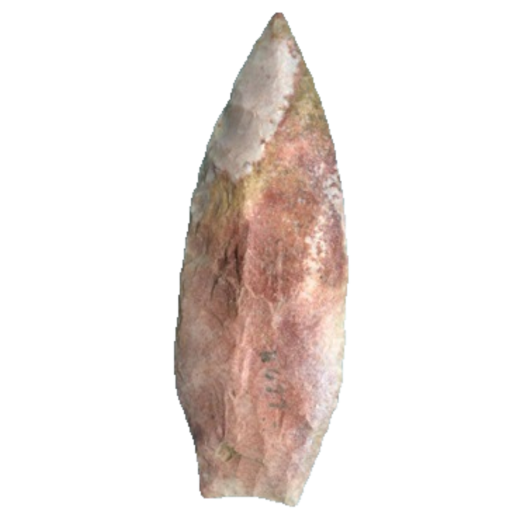
Arrowhead type
Conerly Point
Conerly5,500 - 4,500 B.P.Middle Archaic6 reference photos
Key facts
- Age
- 5,500 - 4,500 B.P.
- Cultural period
- Middle Archaic
- Size
- Medium
- Shape
- Auriculate to Lanceolate to Conracting Stem
- Glacial period
- Middle Holocene
More from the Archaic period
Description
This medium-sized lanceolate point exhibits a robust profile, characterized by an elliptical cross-sectional shape. The curved blade profile is excurvate, with a subtle serration evident along its edges. The shoulder regions are poorly defined, transitioning into a stem that is nearly equivalent in width to the blade, giving the point a distinctive contracted appearance. The basal margin is marked by a concave curvature. In terms of flaking patterns, this point displays a predominantly random arrangement, although occasional instances of oblique transverse flaking can be observed. Additionally, the presence of basal thinning is noted, suggesting a deliberate attempt to refine the point's overall morphology.
Size
The arrowheads exhibit the following dimensional characteristics: - Length ranges from 57 mm to 105 mm, with an average length of 68 mm to 78 mm. - The stem length varies between 11 mm and 20 mm, averaging between 12 mm and 18 mm. - Blade width measurements fall within the range of 21 mm to 34 mm, with an average width of 27 mm to 30 mm. - Stem width dimensions range from 12 mm to 24 mm, with average widths of 19 mm at the top and 16 mm at the base of the stem. - The thickness of the arrowheads is between 9 mm and 12 mm. - Basal concavity is observed to be within the range of 2 mm to 3 mm.
Distribution
This type is mainly located in the Savannah River Valley of Georgia and occasionally extends into the adjacent noted areas
Mainly found in
Also found, less often, in
Additional information
In the realm of Native American archaeology, a specific type of arrowhead has garnered significant attention due to its distinct characteristics and distribution. Initially, these points were referred to as Lively points, named after Mathew Lively, who not only first identified them but also compiled an extensive collection of these artifacts from Alabama. However, they were later reclassified as Conerly points, taking their name from the type site located in Georgia. Interestingly, these points are also sometimes associated with the Briar Creek designation, which is an alternative name for the Guilford Stemmed point.
A notable aspect of these points is their similar distribution, characteristics, and age, suggesting a potential connection between them. The Guilford Stemmed point, also known as the Briar Creek point, shares a comparable geographic and temporal range with the Conerly point, raising questions about their possible equivalence. According to John Whatley's 2002 research, it is likely that these two point types are coeval, implying that they may have been used concurrently by Native American communities. This coexistence highlights the complexity and diversity of prehistoric toolmaking traditions, underscoring the need for continued research into the nuances of these archaeological findings.
The study of these points offers valuable insights into the lives and technologies of Native American groups, particularly in the southeastern United States. By examining the characteristics, distribution, and age of these artifacts, archaeologists can reconstruct the cultural and historical contexts in which they were created and used. The Conerly and Guilford Stemmed points, whether considered distinct or equivalent, contribute significantly to our understanding of the region's prehistoric record, inviting further investigation into the technological, social, and economic dynamics of the communities that produced them. As such, these points remain an important area of study, providing a window into the lives of Native American peoples and their rich cultural heritage.
Identified by
- Named by
- James Cambron and David Hulse
- Year
- 1975
- Type site
- Conerly Site, Burke County, Georgia
Similar types
Types that are easy to confuse with the Conerly point.
- Arredondo
- Beaver Lake
- Copena
- Guilford Yuma
- Marianne
- Nolichucky
- Savannah River
Other types in this cluster
- Guilford
- Guilford Stemmed