
Arrowhead type
Cumberland Point
CumberlandCumberland Cluster11,000 - 9,000 B.P.Transitional Paleo26 reference photos
Key facts
- Age
- 11,000 - 9,000 B.P.
- Cultural period
- Transitional Paleo
- Size
- Medium to Large
- Shape
- Auriculate to Lanceolate
- Material
- Jasper
- Glacial period
- Late Pleistocene to Early Holocene
More from the Paleo period
Description
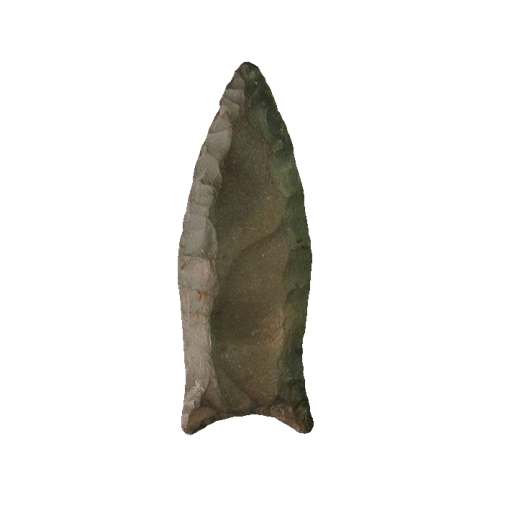
This lanceolate point exhibits a medium to large size, characterized by a distinctive fluted design. In cross-section, the area where the flute is present appears flattened, while the section above the flute assumes an elliptical shape. Notably, a median ridge is visible on the unfluted portion of the tip, suggesting its presence prior to fluting. The blade's outline is marked by an outward recurvate shape, resulting from a constricted waist at the hafting area, which gives rise to pronounced articulations or "ears" as the blade expands outward. The base of the point is concave and features evidence of grinding that may extend up to one-third of the point's length. Short, pressure-flaked flakes are visible at the base, created during the removal of the fluting platform. Both faces of the point display long, extending flakes or flutes that cover between one-third to the entirety of the blade face. The presence of these flutes is a key characteristic, as unfluted examples would not be considered typical of this point type. The overall flaking pattern is collateral, indicating a specific technological approach to the point's manufacture.
Size
The arrowheads exhibit a range of dimensions, with lengths spanning 35 to 105 mm, widths between 15 to 25 mm, and thicknesses varying from 3.5 to 8 mm. Additionally, the basal width measures between 14 to 20 mm, and the basal concavity ranges from 2 to 6 mm.
Distribution
This arrowhead type is mainly concentrated in the Cumberland River valley and extends throughout the Tennessee River valley. It appears less often in the Mississippi River valley and the Ohio River valley. Although scarce, it has been discovered in the Great Lakes area and as far as Minnesota, according to the University of Minnesota. The Cumberland/Barnes point has been identified in Ontario (49 instances), Quebec (3 instances), Nova Scotia (144 instances), and Maine (6 instances) by the 2010 PIBDA, but such findings are rare in these regions and may overlap with the similar Debert point, potentially representing variations of it
Additional information
In the realm of Native American archaeology, a particular type of arrowhead has garnered significant attention due to its distinctive characteristics and widespread distribution. Notably, these points are often discovered in conjunction with Clovis and Dalton points at various archaeological sites. However, a closer examination of their fluting techniques, as observed by Justice in 1987, suggests a stronger affinity with the Folsom point. This observation highlights the complexities of point typology and the need for nuanced analysis in understanding the cultural and technological contexts of these ancient artifacts.
The geographic range of these points is also noteworthy, with finds reported as far north as southern Minnesota. Nevertheless, the presence of these points in this region remains a topic of debate among scholars, underscoring the importance of continued research and verification. The history of scholarly discussion surrounding this point is also intriguing, with early literature referring to it as the Ohio Fluted point, as noted by Bell in 1958. This nomenclature reflects the point's initial discovery and association with the Ohio region, although its distribution and cultural significance extend beyond this area.
A comprehensive understanding of this point type requires consideration of its technological, cultural, and geographic contexts. The fluting techniques employed in its manufacture, for instance, demonstrate a high degree of craftsmanship and attention to detail. Furthermore, the point's association with other notable point types, such as Clovis and Folsom, highlights the complex and dynamic nature of Native American cultural exchange and technological development. As researchers continue to study and refine our understanding of this point type, its significance within the broader narrative of Native American archaeology is likely to become increasingly apparent.
Identified by
- Named by
- Thomas N.M. Lewis
- Year
- 1954
- Type site
- Multiple site in the Cumberland Valley of Tennessee and Kentucky
Similar types
Types that are easy to confuse with the Cumberland point.
- Copena Articulated
- Debert
- Hazel
- Hinds
- Pike County
- Quad
- Wheeler Expanded
Other types in the Cumberland Cluster
- Cumberland Barnes
- Beaver Lake
- Clovis
- Dalton