
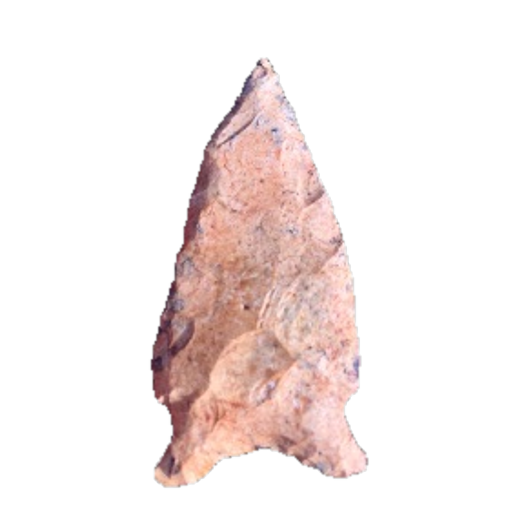
Arrowhead type
Chipola Point
ChipolaDalton Cluster10,000 - 8,000 B.P.Late Archaic to Woodland8 reference photos
Key facts
- Age
- 10,000 - 8,000 B.P.
- Cultural period
- Late Archaic to Woodland
- Size
- Small to Medium
- Shape
- Auriculate to Lanceolate to Bifurcated
- Glacial period
- Early Holocene
Description
This triangular side-notched point exhibits a distinctive elliptical profile, with a predominantly excurvate blade that curves inward at the shoulder edges, resulting in a rounded shoulder morphology. The shoulders themselves are angled upward, forming a subtle yet notable feature. The stem expands downward, terminating in a concave base that gives rise to diagonally oriented, downward-sloping auricles. Characteristically, the base of the point is thinned, often accompanied by evidence of grinding in the hafting region. The flaking pattern observed on this point is random, lacking a discernible order or sequence.
Size
The dimensions of the arrowheads are as follows: they typically range in overall length from 40 to 76 mm, with a mean length of 55 to 65 mm. The stem measures between 13 and 18 mm in length. The blade width varies from 18 to 38 mm, averaging 25 mm. In terms of width, the stem spans 18 to 30 mm, while the waist width ranges from 15 to 25 mm. Additionally, the basal concavity is observed to be between 4 and 10 mm.
Distribution
This type is mainly discovered in the Chipola River Valley of northwest Florida, southwest Georgia, and southeast Alabama. It has also been identified in central Florida, south Georgia, and southeast Alabama
Additional information
In the realm of Native American arrowhead typology, a fascinating point of discussion emerges with the examination of a particular projectile point. Notably, this point bears a striking resemblance to the San Patrice point, predominantly found in Texas and the surrounding regions. Research suggests that both the San Patrice and Chipola points may have originated from the Gulf Coastal Plains tradition, with the San Patrice point being more prevalent in the western areas and the Chipola point in the eastern regions, as proposed by Farr in 2006. This specific point may, in fact, represent a geographical extension of the San Patrice type, highlighting the complexities of cultural exchange and technological diffusion in the region.
A closer inspection of this point reveals similarities with other notable types, including the Dalton Greenbrier and the Hardaway points. One of the distinguishing characteristics of this point is its more angular shoulder, which is the junction where the auricle and the blade meet. This feature is particularly noteworthy, as it may signify a transitional form between the Dalton and Hardaway points, as suggested by Powell in 1990. The presence of such a characteristic underscores the dynamic nature of arrowhead design and the potential for regional variations within broader cultural traditions.
The study of this point offers valuable insights into the technological and cultural developments of Native American communities, particularly in the context of the Gulf Coastal Plains tradition. By examining the morphological characteristics and potential relationships with other point types, researchers can gain a deeper understanding of the historical dynamics that shaped the lives of these communities. The analysis of this point, with its unique blend of features, contributes to a more nuanced comprehension of the complexities of Native American cultural expression and the evolution of arrowhead technology in the region.
Identified by
- Named by
- John Powell
- Year
- 1990
Similar types
Types that are easy to confuse with the Chipola point.
- Dalton
- Dalton Greenbrier
- Gilchrist
- Hardaway