
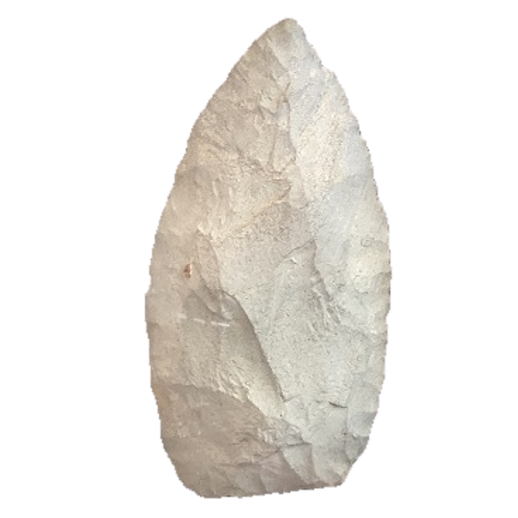
Arrowhead type
Browns Valley Point
Browns ValleyPlano Lanceolate Cluster10,000 - 9,000 B.P.Transitional Paleo6 reference photos
Key facts
- Age
- 10,000 - 9,000 B.P.
- Cultural period
- Transitional Paleo
- Size
- Medium to Large
- Shape
- Lanceolate
- Glacial period
- Late Pleistocene to Early Holocene
More from the Paleo period
Description
This lanceolate point exhibits a slender profile with a medium to large size, characterized by a cross-sectional shape that is notably flattened. The blade itself is distinguished by its broad, outwardly curved (excurvate) shape, with its maximum width occurring precisely at the blade's midpoint. The basal edge of the point can range from being straight to subtly concave, and it has been thinned through the removal of multiple vertical pressure flakes from both its faces, typically involving three or more flakes. A common feature of this point type is the presence of pronounced basal grinding. The manufacturing technique employed involves a combination of even percussion flaking and fine pressure flaking, resulting in a flaking pattern that transitions smoothly from a horizontal orientation to a parallel oblique arrangement. While some specimens may display a more random flaking pattern, the overall workmanship remains consistently high, underscoring the skill of the point's creator.
Size
The dimensions of the arrowheads are characterized by a total length ranging from 60 to 114 mm, with a mean length typically falling between 70 to 80 mm. Additionally, the blade width spans from 28 to 38 mm.
Distribution
This is an uncommonly discovered point with its main occurrence in the eastern prairies immediately west of the Mississippi River Basin, ranging from Minnesota southward to Mississippi. The greatest densities are noted in Minnesota.
Mainly found in
Also found, less often, in
Additional information
The scare point is a distinctive archaeological artifact that has been predominantly found in the state of Minnesota. Notably, the majority of these discoveries have been concentrated in a specific county, which is also the designated type site for this particular point style. This geographic correlation suggests a significant cultural association between the scare point and the prehistoric populations that inhabited this region, particularly within the boundaries of the aforementioned county, referred to as W2.
The prevalence of scare points in Minnesota, and more specifically within the type site county, provides valuable insights into the technological and stylistic preferences of the Native American groups that once flourished in this area. The fact that most examples of scare points have been recovered from this region implies a strong cultural affinity, which may be indicative of a distinct technological tradition or stylistic influence that was unique to this geographic locale.
Further examination of the scare point's distribution and characteristics may reveal additional information about the cultural dynamics and exchange networks that existed among Native American communities in Minnesota during the time period in which these artifacts were created. By analyzing the scare point's morphology, material composition, and spatial distribution, researchers can gain a deeper understanding of the historical context in which these artifacts were produced and used, ultimately shedding more light on the lives and traditions of the prehistoric populations that once inhabited this region.
Identified by
- Named by
- Albert E. Jenks
- Year
- 1937
- Type site
- Brown Valley site (21TR5), Browns Valley, Traverse County, Minnesota
Similar types
Types that are easy to confuse with the Browns Valley point.