
Arrowhead type
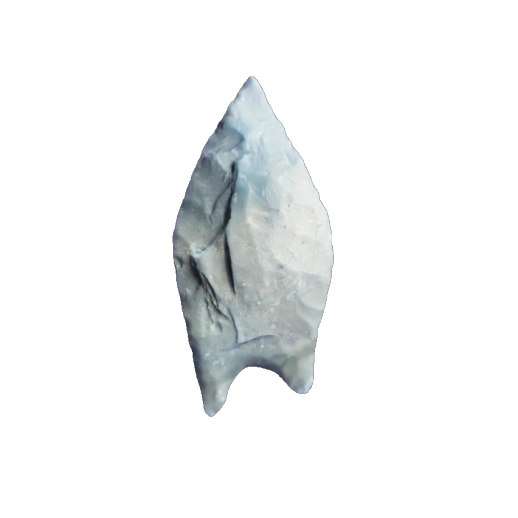
Barber Point
BarberPlano Lanceolate Cluster10,000 - 9,000 B.P.Middle Archaic11 reference photos
Key facts
- Age
- 10,000 - 9,000 B.P.
- Cultural period
- Middle Archaic
- Size
- Small to Medium
- Shape
- Lanceolate
- Glacial period
- Early Holocene
More from the Archaic period
Description
This lanceolate point exhibits a distinctive elliptical profile, with its blade curving outward from the midpoint before tapering inward towards the base, occasionally forming a basal ear with a pronounced inward curvature. The maximum blade width is situated approximately at the midpoint, while the base is characterized by a deep concavity and extensive basal grinding, indicating deliberate edge modification. The flaking pattern on this point is notable for its parallel oblique arrangement, suggesting a high degree of technical skill in its manufacture.
Size
The dimensions of the arrowheads are characterized by a total length ranging from 40 to 90 mm, a blade width spanning 23 to 35 mm, and a basal concavity measuring between 7 and 13 mm.
Distribution
This type is mainly located in the heart of Texas.
Mainly found in
Additional information
Noteworthy among Texas Paleo points is the exceptional basal concavity exhibited by this particular specimen. As observed by Turner and Hester in their 1985 study, this point boasts the most pronounced basal concavity of any known Texas Paleo point, setting it apart from others within this cultural and geographical context. This distinctive characteristic underscores the significance of this artifact, offering valuable insights into the technological and stylistic preferences of the Paleoindian groups that inhabited the region.
Identified by
- Named by
- Thomas C. Kelly
- Year
- 1983
- Type site
- The Barber Paleo-Indian Point, Texas
Similar types
Types that are easy to confuse with the Barber point.