
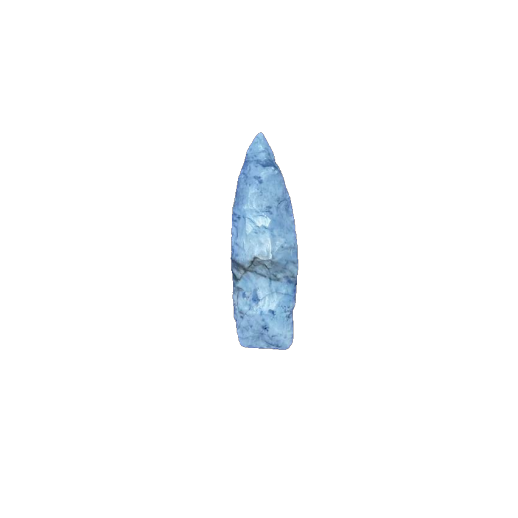
Arrowhead type
Agate Basin Point
Agate BasinPlano Lanceolate Cluster1B,550 - 9,350 .P.Transitional Paleo24 reference photos
Key facts
- Age
- 1B,550 - 9,350 .P.
- Cultural period
- Transitional Paleo
- Size
- Medium to Large
- Shape
- Lanceolate to Ovoid
- Material
- Agate
- Glacial period
- Late Pleistocene to
More from the Paleo period
Description
This lanceolate point exhibits a slender, elongated profile, measuring between 2.5 and 5.25 inches in length, with a cross-sectional shape that is elliptical in form. The thickness of the blade is characterized by a width-to-thickness ratio of 2:1 to 3:1, indicating a relatively flat, narrow morphology. The blade's curvature is excurvate, with a symmetrical outline that converges towards the base, while the midpoint of the blade tends to be parallel. Typically, the widest portion of the blade is situated in the middle to lower third of the point. The base of the point is generally straight, although it may occasionally exhibit a slight convexity, never concave. Notable features include heavy grinding on the basal regions intended for hafting, whereas basal thinning is absent. Lateral edge grinding is a consistent feature, often extending to the blade's widest point, although some specimens may lack basal grinding. The flaking pattern on these points is predominantly random, with occasional examples displaying collateral or horizontal transverse patterns, overall reflecting a high level of craftsmanship.
Size
The dimensions of the arrowheads are as follows: they range in length from 33 to 147 mm, with a typical length of 55 to 70 mm. In terms of width, they measure between 18 and 39 mm, with an average width of 24 mm. The basal width varies from 10 to 23 mm, averaging 17 mm. Additionally, the thickness of the arrowheads falls within a range of 6 to 10 mm, with an average thickness of 8 mm.
Distribution
This arrowhead type is mainly linked to the Grasslands area (Prairies and Upland Prairies) of North America. It occurs extensively throughout the Central States and into the Northern Grasslands. May occur as far as Texas and southwestern Ohio. This arrowhead has been discovered at Grants Lake Nunavut Canada and the Northwest Territories. This type is seldom encountered in the Eastern United States, but has been discovered at Plenge, Pennsylvania. This type seldom stretches west beyond the Continental Divide, but has been discovered as far as Oregon. This type has been uncovered in the Tehuacan Valley in Mexico and the Valley of Mexico
Mainly found in
- Washington
- Idaho
- Montana
- North Dakota
- Minnesota
- Wisconsin
- Michigan
- Pennsylvania
- New York
- Connecticut
- Rhode Island
- New Jersey
- Delaware
- Maryland
- West Virginia
- Ohio
- Indiana
- Illinois
- Iowa
- South Dakota
- Wyoming
- Oregon
- California
- Nevada
- Utah
- Colorado
- Nebraska
- Kansas
- Missouri
- Kentucky
- Tennessee
- Alabama
- Mississippi
- Louisiana
- Oklahoma
- Texas
- New Mexico
- Arizona
- Canada
- Mexico
Additional information
In the realm of Native American archaeology, the Agate Basin point is a distinctive type that has often been misclassified due to its similarities with other lanceolate points. However, genuine Agate Basin points are characterized by their exceptional craftsmanship, exhibiting a high degree of workmanship that sets them apart from other types. Notably, even when crafted from inferior materials, these points consistently display an even and symmetrical blade, underscoring the skill of their creators. A key diagnostic feature of true Agate Basin points is their base shape, which is typically straight or slightly convex. In contrast, points with a concave base do not conform to the characteristics of this type, as emphasized by Morrow (2016).
The stratigraphic positioning of Agate Basin points in excavated sites provides valuable insights into their chronological context. According to Frison (1991), Agate Basin points are consistently found in layers above Folsom points, suggesting a temporal relationship between the two types. Furthermore, radiocarbon dating has revealed that there may be some overlap between the Agate Basin and Folsom types, implying a complex and potentially concurrent development of these point styles. This overlap highlights the need for careful consideration of the archaeological record to accurately interpret the cultural and historical significance of these artifacts.
The distinctive characteristics of Agate Basin points, combined with their strategic positioning in the archaeological record, offer a unique window into the lives and technologies of the Native American cultures that created them. By examining the technical expertise and design choices embodied in these points, researchers can gain a deeper understanding of the cultural and historical contexts in which they were crafted. As such, the study of Agate Basin points continues to be an important area of research in Native American archaeology, providing valuable insights into the lives and traditions of the peoples who created these remarkable artifacts.
Identified by
- Named by
- Frank H. H. Roberts Jr. and Maria Wormington
- Year
- 1943
- Type site
- Agate Basin Site, eastern Wyoming
Similar types
Types that are easy to confuse with the Agate Basin point.
- Guilford Straight Base
- Lerma
- Nebo Hill
- Ohio Lanceolate
- Sedalia
- Varney
- Park Hill
- Tamaulipas Triangular