
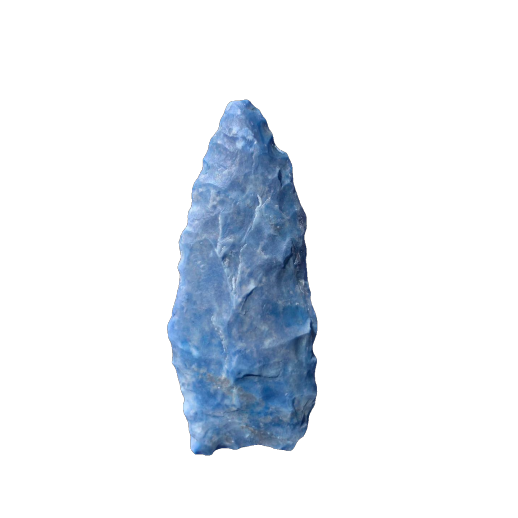
Arrowhead type
Angostura Point
AngosturaPlano Lanceolate Cluster10,000 - 8,000 B.P.Transitional Paleo to Early Archaic36 reference photos
Key facts
- Age
- 10,000 - 8,000 B.P.
- Cultural period
- Transitional Paleo to Early Archaic
- Size
- Medium to Large
- Shape
- Lanceolate
- Material
- Agate
- Glacial period
- Late Pleistocene to Early
Description
This lanceolate point typically measures between 3 inches in length, exhibiting a characteristic elliptical cross-section. Its shape can vary from a classic, symmetrical lanceolate form to a more subtly articulated silhouette. The blade itself is slender, often featuring an inward recurvate profile, with the midpoint marking the widest section. The base of the point can range from a straight edge to a concave curve, sometimes displaying evidence of basal thinning achieved through the strategic removal of flakes using vertical pressure flaking techniques. Additional characteristics include basal grinding and grinding along the lateral edges. The flaking pattern on these points is predominantly oblique and parallel, although random flaking is also a common occurrence. The manufacturing process involves even percussion flaking, which yields long, ribbon-like pressure flakes that create a parallel oblique pattern, sometimes interspersed with random flaking. Less frequently observed is a horizontal transverse flaking pattern, adding to the point's technological and typological complexity.
Size
The arrowheads exhibit a range of dimensions, with lengths spanning from 50 to 105 mm, and an average length of 76 mm. The blade width varies between 18 and 42 mm, with a mean width of 28 mm. In terms of thickness, these artifacts have an average measurement of 9 mm.
Distribution
These artifacts are mainly discovered in the Grassland areas of the United States and extending into the Grasslands of Canada. They have been identified eastward into the Great Lakes area and into the Tennessee River valley. They have been uncovered as far south as the Rio Grande River Basin of Texas and Mexico and into the adjacent territories
Mainly found in
Additional information
In the realm of Native American archaeology, a specific type of arrowhead has been identified and reclassified over time to reflect its unique characteristics and geographical associations. Initially, these points were referred to as "Long Point" due to their discovery at the Ray Long Site, situated near the Angostura Reservoir. However, to avoid potential confusion and ensure clarity, R. P. Wheeler later renamed them "Angostura points" in reference to the reservoir where the site is located, as documented by Cambron and Hulse in 1964. This renaming was deemed necessary to prevent the term "Long" from being misconstrued as a descriptive feature rather than a site-specific designation.
A notable aspect of the Angostura point is its similarity to the Plainview point, with which it shares certain characteristics. Nevertheless, a distinguishing feature of the Angostura point is its distinctly narrower base compared to the Plainview point, as observed by Suhm and Krieger in 1954. This subtle yet significant difference underscores the importance of precise classification and terminology in archaeological research. The Texas Angostura Type, as it has come to be known, represents a unique variant within the broader context of Native American arrowhead typology, offering valuable insights into the cultural and technological practices of the region's indigenous populations.
The reclassification of the Angostura point highlights the ongoing refinement of archaeological knowledge and the need for precise terminology. By recognizing and addressing potential sources of confusion, researchers can ensure that their findings are accurately conveyed and understood. In the case of the Angostura point, its distinctive characteristics and geographical associations have been carefully documented, providing a nuanced understanding of this particular type of arrowhead and its place within the larger narrative of Native American cultural and technological development.
Identified by
- Named by
- Jack Hughes and R. P. Wheeler
- Year
- 1949
- Type site
- The Ray Long Site (39FA65), Angostura Reservoir, South Dakota
Similar types
Types that are easy to confuse with the Angostura point.