
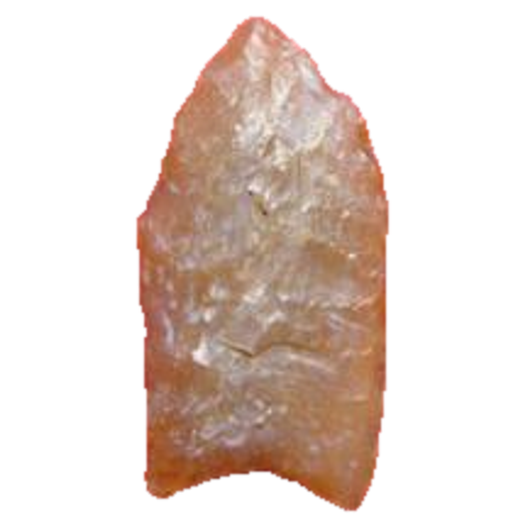
Arrowhead type
Bat Cave Point
Bat CavePlano Lanceolate Cluster9,000 - 8,000 B.P.Early ArchaicKey facts
- Age
- 9,000 - 8,000 B.P.
- Cultural period
- Early Archaic
- Size
- Small
- Shape
- Lanceolate
- Glacial period
- Early Holocene
More from the Archaic period
Description
This slender, lance-shaped point exhibits a cross-sectional profile that ranges from elliptical to compressed, yielding a notably thin overall form. The blade's curvature can vary, transitioning from an outwardly curved (excurvate) to an inwardly curved (recurvate) shape, with the tip often bending inward and narrowing at the waist before expanding outward toward the base. In instances where the waist is markedly constricted, the point may display a side notch or ear-like protrusions. The basal region is characterized by a concave shape and deliberate basal thinning, indicative of careful craftsmanship. The flaking pattern observed on this point is random, lacking a discernible order or orientation.
Size
The dimensions of the arrowheads are characterized by a total length ranging from 32 to 55 mm, with a mean length of 50 mm. The width of the blade spans from 20 to 35 mm, averaging 23 mm. In terms of thickness, the measurements fall between 3 and 6 mm.
Distribution
This type is mainly discovered in the southern regions of New Mexico and extending into southern Arizona, southeastern California and onwards to northwestern Chihuahua, and northern Sonora, Mexico
Mainly found in
Also found, less often, in
Additional information
More information needed.
Identified by
- Named by
- Herbert W. Dick
- Year
- 1965
- Type site
- Bat Cave, New Mexico
Similar types
Types that are easy to confuse with the Bat Cave point.
- Duncan
- Hanna
- Humboldt