
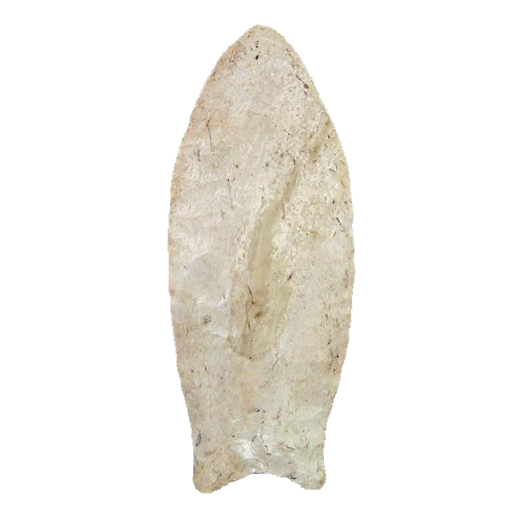
Arrowhead type
Clovis Hazel Point
Clovis HazelClovis Cluster14,000 - 10,000 B.P.Paleo8 reference photos
Key facts
- Age
- 14,000 - 10,000 B.P.
- Cultural period
- Paleo
- Size
- Small to Medium to Large
- Shape
- Auriculate to Lanceolate
- Glacial period
- Late Pleistocene
More from the Paleo period
Description
This lanceolate point exhibits a distinctive auriculated profile, characterized by a hexagonal cross-sectional shape. Its recurvate blade tapers inward at the waist, creating a pronounced constriction. Notably, the blade dimensions are more extensive than those typically observed in other Clovis variants, with a length and width that surpass the norm. The point's silhouette is further defined by a waist that constricts before flaring outward toward the base, yielding a distinctive "fishtail" morphology. The basal edge is marked by a concave curvature. Upon closer inspection, the central region of each face reveals a pattern of three to five large, flat flake scars, accompanied by finer, more delicate pressure flaking along the margins. The fluting on this point is relatively short, rarely extending beyond one-third of the face's length.
Size
The dimensions of the arrowheads are characterized by the following measurements: overall length ranges from 50 to 100 mm, with a mean length of 75 to 85 mm. The blade width spans 20 to 40 mm. Notably, the waist width is consistently 5 to 10 mm less than the blade width. The base of the arrowhead is broader than the waist, yet narrower than the blade, exhibiting a distinct proportional relationship between these dimensions.
Distribution
This point is mainly located in the Ohio River valley, Tennessee River Basin, and the Great Lakes area
Mainly found in
Also found, less often, in
Additional information
In the realm of Native American arrowheads, the Hazel variation is notable for its distinctive "fishtail" appearance, which is often regarded as a characteristic feature of this type. According to Granger and Granger (2013), this variation represents a continuum of fluted, waisted points that originated with the Clovis point and evolved over time, eventually giving rise to other types such as the Suwannee and Simpson points. This classification is consistent with the work of G. E. Van Burten, who identified the Hazel sub-type in his 1974 book on projectile points.
The classification of Clovis-style points remains a topic of debate among archaeologists, with some arguing that the characteristics that define this type are subject to normal variation and can be observed throughout the distribution of Clovis points. Others propose that specific regions developed specialized variants of the Clovis point, which are more frequently found in those areas. This perspective suggests that these regional variants represent later adaptations and unique subtypes of the Clovis point, highlighting the complexity and diversity of Native American arrowhead technology.
The Hazel variation, in particular, exemplifies the challenges of classifying Clovis-style points, as its distinctive features can be seen as either a normal variation of the Clovis type or a distinct subtype that emerged in response to regional preferences or technological innovations. Regardless of how it is classified, the Hazel variation remains an important part of the archaeological record, offering insights into the evolution of Native American arrowhead technology and the cultural exchange networks that shaped the development of these artifacts. By examining the characteristics and distribution of the Hazel variation, researchers can gain a deeper understanding of the technological and cultural contexts in which these arrowheads were created and used.
Identified by
- Named by
- Arthur G. Smith
- Year
- 1965
Similar types
Types that are easy to confuse with the Clovis Hazel point.
- Alder
- Barnes
- Beaver Lake
- Copena Articulated
- Crowfield
- Cumberland
- Dalton
- Golondrina
- Folsom
- Northumberland
Other types in the Clovis Cluster
- Anzick
- Clovis
- Clovis St Louis
- Clovis Tulare
- Clovis Un-fluted
- Debert
- Holcombe
- Redstone