
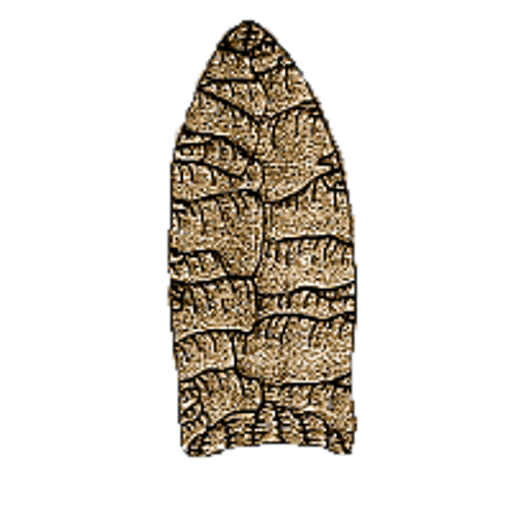
Arrowhead type
Belen Point
BelenPlano Lanceolate Cluster10,500 - 9,000 B.P.Late Archaic3 reference photos
Key facts
- Age
- 10,500 - 9,000 B.P.
- Cultural period
- Late Archaic
- Size
- Small to Medium
- Shape
- Lanceolate
- Material
- Agate
- Glacial period
- Late Pleistocene to Early Holocene
More from the Archaic period
Description
This slender, lanceolate point exhibits a cross-sectional profile that transitions from elliptical to plano-convex. The blade's curvature is characterized by an excurvate shape, where the tip is reflexed and the edges converge, becoming parallel before subtly recurving towards the base. Notably, the base is marginally narrower than the blade, with a morphology that can range from straight to concave. The presence of grinding on the base and hafting region is a distinctive feature of this type. The secondary flaking pattern, which overlays the primary flaking, can manifest in various arrangements, including parallel, oblique, or random configurations, thereby obscuring the underlying primary flake scars.
Size
The dimensions of these arrowheads are characterized by a total length ranging from 26 to 45 mm, with the blade width spanning 14 to 28 mm. The base of the arrowhead measures between 13 and 22 mm in width, while the thickness varies from 4 to 7 mm, as determined from a limited dataset.
Distribution
This artifact is mainly discovered in the central Rio Grande valley of southern New Mexico and western Texas
Mainly found in
Additional information
In the realm of Paleoindian archaeology, a particular type of arrowhead has garnered significant attention due to its distinctive characteristics and potential associations with other notable point styles. According to Cordell's 1979 research, this type is situated chronologically between the Folsom point and the Cody Complex, sparking intriguing discussions about its origins and classification. One theory suggests that this type may be a variant of the Plainview point, while a more recent argument proposes that it could represent a heavily re-sharpened Milnesand point, highlighting the complexities of point typology and the need for ongoing analysis.
A seminal study conducted by James Judge in 1973 provides valuable insights into this arrowhead type, shedding light on its significance within the broader context of Paleoindian occupation. Judge's research, as presented in "Paleo-Indian Occupation of the Central Rio Grande Valley in New Mexico," published by the University of New Mexico Press, offers a comprehensive examination of the archaeological record in this region. By exploring the characteristics and distribution of this arrowhead type, Judge's work contributes substantially to our understanding of the cultural and technological dynamics at play during this period.
The ongoing debate surrounding the classification and origins of this arrowhead type underscores the importance of continued research and analysis in the field of Paleoindian archaeology. As scholars continue to refine our understanding of the Plainview and Milnesand points, as well as the Folsom point and Cody Complex, a more nuanced picture of the technological and cultural developments among early Native American populations will emerge. By building upon the foundational work of researchers like Cordell and Judge, archaeologists can further illuminate the complexities of Paleoindian culture and the significance of these enigmatic arrowheads within the rich cultural heritage of Native American communities.
Identified by
- Named by
- Ele Baker
- Year
- 1968
Similar types
Types that are easy to confuse with the Belen point.