
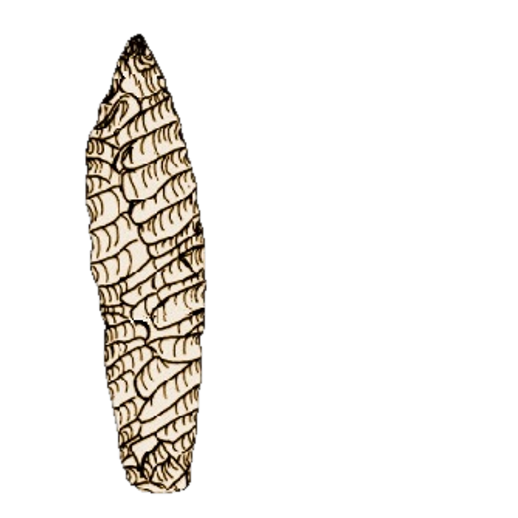
Arrowhead type
Alder Point
AlderPlano Lanceolate Cluster10,000 - 9,000 B.P.Late PaleoKey facts
- Age
- 10,000 - 9,000 B.P.
- Cultural period
- Late Paleo
- Size
- Small to Medium
- Shape
- Lanceolate
- Material
- Agate
- Glacial period
- Early Holocene
More from the Paleo period
Description
This lanceolate point exhibits a slender, elongated form with an elliptical profile. Its excurvate blade features a distinctive curvature, where the tip recurves inward before sweeping back towards the base. The maximum blade width is situated approximately at the midpoint, lending a sense of balance to the overall shape. The basal edge ranges from straight to subtly concave. The flaking pattern on this point is characterized by parallel to oblique scars, indicative of a deliberate and controlled flaking technique.
Size
Small to Medium
Distribution
This type is mainly linked to the Ruby Valley in Montana and adjacent areas.
Mainly found in
Additional information
In the realm of Native American archaeology, a distinct type of arrowhead has been identified, commonly referred to as either the Alder Complex or Ruby Valley point. This classification is derived from the Alder Complex in Montana, as well as the Ruby Valley site, where these points were initially discovered and dated to the Alder Complex period. Notably, excavations at Baron Gulch have uncovered these points in stratigraphic layers beneath those containing Metzal points, which are associated with the Hardinger Complex and dated to approximately 8,700 years before present (Gibson and Ames, 1998).
The Ruby Valley point exhibits similarities with other Transitional Paleo points, such as the James Allen and Fredrick points, in terms of its flaking patterns. However, a distinctive characteristic of the Ruby Valley point is its relatively smaller size compared to other points from the same regional and temporal context (Bousman and Vierra, 2012). The origins of this point type's nomenclature can be traced back to Davis et al. (1988), who are credited with first referencing this specific type, although the original publication remains elusive. In academic circles, these points are formally recognized as Ruby Valley Projectile Points, while collectors often refer to them as Alder Complex points, highlighting the dual terminology used to describe these artifacts.
The study of Ruby Valley points offers valuable insights into the technological and cultural developments of Native American communities during the Transitional Paleo period. The presence of these points at sites like Baron Gulch provides a glimpse into the lives of ancient hunter-gatherer groups, shedding light on their subsistence strategies, mobility patterns, and social interactions. As researchers continue to investigate these points, they contribute to a more nuanced understanding of the complex cultural landscape of North America's past, underscoring the significance of meticulous archaeological analysis and the importance of preserving our cultural heritage.
Identified by
- Type site
- Baron Gulch (24MA171) , Ruby Valley, Madison County, Montana
Similar types
Types that are easy to confuse with the Alder point.
- Allen
- Agate Basin
- Browns Valley
- Clovis
- Fredrick
- Green River
- Lovell
- Meserve