
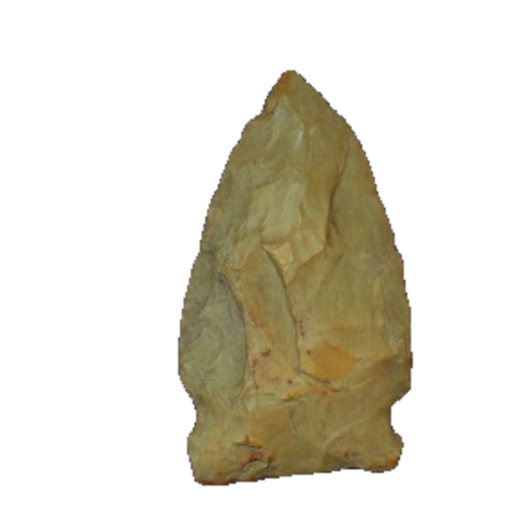
Arrowhead type
Reigh Point
ReighLarge Side Notch Cluster3,500 - 2,000 B.P.Late Archaic to Early Woodland4 reference photos
Key facts
- Age
- 3,500 - 2,000 B.P.
- Cultural period
- Late Archaic to Early Woodland
- Culture
- Old Copper Culture
- Size
- Medium
- Shape
- Side Notch
- Material
- Copper
- Glacial period
- Neoglacial to Roman Warm
Description
This side-notched point exhibits a stout, medium-sized profile with an elliptical cross-sectional shape. Its excurvate blade features small, V-to-U-shaped notches positioned near the base, resulting in a broad neck. The shoulders are characterized by a range of orientations, from horizontal to slightly elevated, and are accompanied by an expanded stem. The base of the point is narrow and wide, lacking any evidence of grinding in the basal or hafting regions. The manufacturing technique employed is random percussion flaking, supplemented by limited pressure flaking, yielding a flaking pattern that appears random and unplanned. Overall, the point's construction is consistent with a crude, utilitarian approach.
Size
The dimensions of the arrowheads are as follows: they range in overall length from 40 to 90 mm, with stem lengths varying between 7 and 11 mm. The width of the blade spans from 32 to 50 mm, while the depth of the notch measures between 2 and 4 mm. Additionally, the stem width is consistent with the blade width, also measuring between 32 and 50 mm.
Distribution
These artifacts are mainly located in southern Wisconsin and extend into southeastern Minnesota, northeastern Iowa, and northern Illinois
Additional information
In recent years, a compelling argument has emerged within the archaeological community, suggesting that the Madison Side Notch point and the Reigh point may, in fact, be one and the same (Morrow, 2016). This notion has sparked intriguing discussions among researchers, as it highlights the complexities and nuances of projectile point typology. The Madison Side Notch point, a distinctive type of arrowhead, has been the subject of extensive study, and its potential equivalence to the Reigh point warrants further examination. By exploring the characteristics and distributions of these points, scholars can gain a deeper understanding of the cultural and technological developments of the Native American groups that crafted them.
The proposition that the Madison Side Notch point and the Reigh point are equivalent is rooted in a thorough analysis of their morphological and metric attributes. As researchers continue to investigate the similarities and differences between these point types, they may uncover new insights into the lives and traditions of the indigenous peoples who created them. The work of Morrow (2016) has contributed significantly to this ongoing discussion, providing a foundation for future studies to build upon. By synthesizing the available data and reevaluating the classification of these points, archaeologists can refine their understanding of the historical context in which they were produced and used.
The potential conflation of the Madison Side Notch point and the Reigh point underscores the importance of meticulous research and careful consideration in the field of archaeology. As scholars strive to reconstruct the past, they must navigate the complexities of material culture and the nuances of human history. The study of projectile points, such as the Madison Side Notch and Reigh points, offers a unique window into the lives of Native American communities, revealing aspects of their technological, social, and cultural practices. Through continued investigation and analysis, researchers can work towards a more comprehensive understanding of these enigmatic artifacts and the people who created them.
Identified by
- Named by
- Robert E. Ritzenthaler
- Year
- 1957
- Type site
- Reigh and Oconto sites, eastern Wisconsin
Similar types
Types that are easy to confuse with the Reigh point.
Other types in the Large Side Notch Cluster
- Big Sandy
- Cache River
- Godar
- Graham Cave
- Greenbrier
- Hemphill
- Howard County
- Madison Side Notched
- Osceola
- Osceola Greenbrier
- Simonsen