
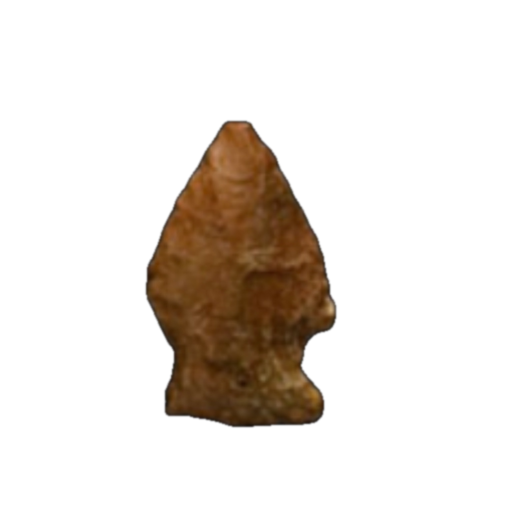
Arrowhead type
Ansell Point
Ansell3,000 - 2,000 B.P.Classic to Historic3 reference photos
Key facts
- Age
- 3,000 - 2,000 B.P.
- Cultural period
- Classic to Historic
- Size
- Small to Medium
- Shape
- Side Notch
- Glacial period
- Neoglacial to Roman Warm
More from the Preclassic and Classic, Historic periods
Description
This artifact is characterized by a medium-sized profile, measuring between 2.5 and 3.3 inches in length, with a distinctive elliptical shape in cross-section. The blade exhibits an excurvate curvature, while the shallow side notches are positioned low on the blade, creating a shoulder that slopes upward. The stem morphology varies, ranging from expanding to straight or contracting forms. A straight base provides a stable foundation for the point. The flaking pattern observed on this specimen is random, lacking a discernible order or sequence.
Size
The dimensions of the arrowheads are as follows: they range in overall length from 35 to 85 mm, with stem lengths varying between 9 and 15 mm. The width of the blade spans from 18 to 28 mm, while the neck width falls within the range of 13 to 21 mm. Additionally, the stem width measures between 18 and 25 mm. It is worth noting that these measurements are based on a limited dataset.
Distribution
This type is mainly discovered in the Illinois River Valley and extending into the adjacent areas.
Additional information
In the realm of Native American arrowhead typology, a particular type has been traditionally grouped within the Matanzas Cluster. However, a critical reevaluation by Justice in 1987 suggests that this classification may be misguided. According to Justice, the technological characteristics that define this arrowhead type are not consistently aligned with those of the Matanzas Cluster. Instead, a closer examination reveals that the manufacturing techniques and stylistic features of this type bear a stronger resemblance to those found in the Chester or Copena clusters. This observation underscores the complexity and nuance of arrowhead typology, highlighting the need for ongoing refinement and precision in our understanding of these ancient artifacts. By recognizing the distinct technological signatures of different clusters, researchers can gain a deeper insight into the cultural exchange networks, technological traditions, and historical contexts that shaped the lives of Native American communities.
Identified by
- Named by
- Anta Montet-White
- Year
- 1968
Similar types
Types that are easy to confuse with the Ansell point.