
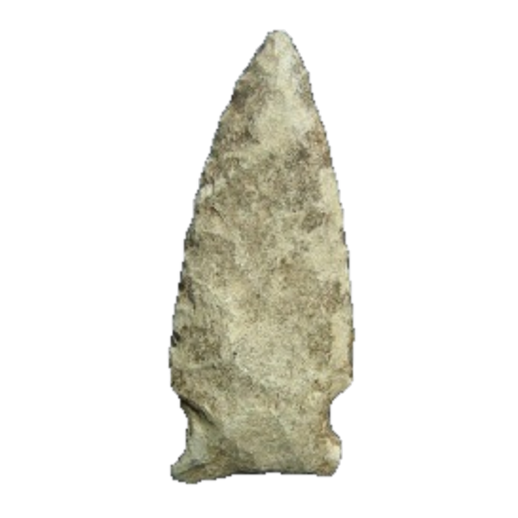
Arrowhead type
Brannon Point
BrannonLarge Side Notch Cluster6,500 - 6,000 B.P.Transitional Paleo to Early Archaic3 reference photos
Key facts
- Age
- 6,500 - 6,000 B.P.
- Cultural period
- Transitional Paleo to Early Archaic
- Size
- Medium to Large
- Shape
- Side Notch to Auriculate
- Glacial period
- Middle Holocene
Description
This triangular point exhibits a distinctive side notch configuration, characterized by a medium-sized profile and an elliptical cross-sectional shape. The blade's curvature is predominantly excurvate, with parallel notches situated low on the blade, giving rise to horizontal shoulders and a broadened stem. The basal morphology is marked by a subtle variation, ranging from a slightly concave to a more pronounced concave shape. The flaking pattern on this point is irregular and non-directional, lacking a discernible order or orientation.
Size
The dimensions of the arrowheads are as follows: they range in overall length from 76 to 140 mm, with stem lengths varying between 13 and 20 mm. The width of the blade spans from 22 to 35 mm, while the notch depth typically measures 3 mm, although it can fluctuate between 2 and 4 mm. Additionally, the stem width is consistent with the blade width, ranging from 22 to 35 mm.
Distribution
This type is mainly discovered in southern Illinois' western regions and extends into Missouri's eastern areas, but possibly shares a similar geographic range as the Godar point
Additional information
In a notable observation, Martens (2009) highlights a distinctive characteristic of the Brannon type, which is marked by notches that are approximately 50% smaller than those found on the classic Godar point. This subtle difference in notch size can lead to confusion among archaeologists, particularly in the greater St. Louis area. The Brannon point is often categorized alongside the Godar point, rather than being recognized as a distinct type, which may be attributed to the regional preference for not using the Raddatz name. As a result, the Brannon point is frequently subsumed under the broader Godar point category, underscoring the need for careful consideration of morphological variations in the classification of these archaeological artifacts.
The distinction between the Brannon and Godar points is significant, as it reflects the complexities of projectile point typology in Eastern North America. The smaller notches on the Brannon type may indicate a specific functional or stylistic preference, highlighting the diversity of technological and cultural expressions among prehistoric societies. By recognizing and documenting these subtle differences, archaeologists can gain a more nuanced understanding of the cultural and historical contexts in which these points were produced and used.
The conflation of the Brannon and Godar points in the greater St. Louis area serves as a reminder of the importance of regional awareness and taxonomic precision in archaeological research. As scholars continue to refine our understanding of these projectile point types, it is essential to consider the variations in notation and classification that exist across different regions and research traditions. By doing so, we can work towards a more comprehensive and accurate picture of the technological, cultural, and historical landscapes of Native American societies, and shed new light on the significance of these enigmatic artifacts.
Identified by
- Named by
- Thomas Cook
- Year
- 1976
- Type site
- Koster Site, Green County, Illinois
Similar types
Types that are easy to confuse with the Brannon point.
Other types in the Large Side Notch Cluster
- Big Sandy
- Cache River
- Godar
- Graham Cave
- Greenbrier
- Hemphill
- Howard County
- Madison Side Notched
- Osceola
- Osceola Greenbrier
- Simonsen