
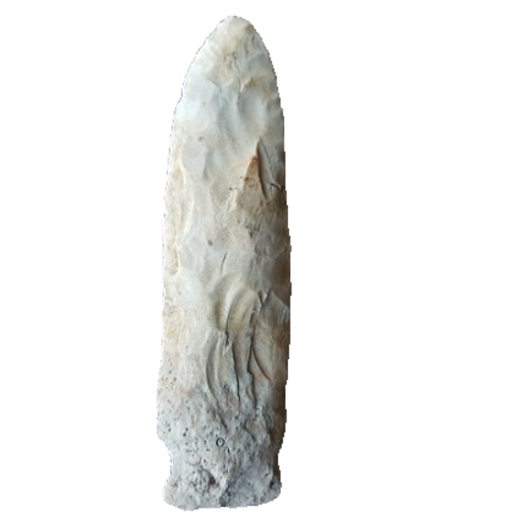
Arrowhead type
Matanzas Point
MatanzasMatanzas Cluster5,700 - 3,000 B.P.Middle Archaic to Late Archaic24 reference photos
Key facts
- Age
- 5,700 - 3,000 B.P.
- Cultural period
- Middle Archaic to Late Archaic
- Size
- Small to Medium
- Shape
- Side Notch to Expanding Stem
- Glacial period
- Middle Holocene to Neoglacial
More from the Archaic period
Description
This medium-sized, triangular point features a distinctive side-notched configuration. In cross-section, its profile can range from an elliptical shape to one with a pronounced median ridge. The blade itself is elongated, moderately slender, and exhibits an excurvate curvature, accompanied by wide, parallel notches that span its length. Notch depth varies in relation to their placement on the blade, with those situated higher up tending to be wider and more shallow, while lower-placed notches are typically narrower and more pronounced. The shoulders of the point are generally inclined upwards, although their orientation can vary to a more horizontal position. The stem expands outward, terminating in a base that is either straight or slightly convex. The basal corners can be either rounded or pointed, often displaying evidence of basal thinning, as well as light to moderate basal grinding. The point's manufacture involves an initial stage of random percussion flaking, followed by a finishing process of pressure flaking, resulting in a random, multi-directional flaking pattern.
Size
The dimensions of the arrowheads are characterized by the following measurements: overall length ranges from 35 to 95 mm, with a typical average length of 40 to 65 mm. The stem length, measured to the junction with the shoulder blade, varies between 10 and 20 mm. The width of the blade spans 18 to 34 mm, with an average width of 15 to 30 mm. The notch depth and corresponding neck width are measured at 2 to 4 mm in depth and 12 to 29 mm in width, respectively. Additionally, the stem width is recorded as ranging from 16 to 34 mm.
Distribution
This projectile is mainly discovered in the central Mississippi River basin and extending into the Illinois River basin, southern to central Ohio River basin, and the southern Missouri River basin. This projectile is located with decreased regularity into Minnesota
Also found, less often, in
Additional information
In a seminal study published in 1976, Cook established a classification system for a particular type of arrowhead, categorizing them into five distinct classes based on notch dimensions. These classes, which provide a framework for understanding the variability within this arrowhead type, include the Modal, Flared Stem, Faint Side Notched, Deep Side Notch, and Straight Stem classes. Notably, the Modal class is widely recognized as the standard type, as identified by Munson and Harn, and has been further corroborated by Justice in 1987.
A closer examination of the classes reveals that the Shallow Side Notch class is characterized by its distinctive placement, situated very low on the blade. This unique positioning imparts a distinctive appearance to the arrowhead, bearing a resemblance to other notable point types, such as the Godar and Raddatz points. As observed by Justice in 1987, the Shallow Side Notch class exhibits a specific morphology that sets it apart from other classes within this arrowhead type. By examining the characteristics of each class, researchers can gain a deeper understanding of the technological and cultural contexts in which these arrowheads were produced and used.
The classification system developed by Cook has proven to be a valuable tool for archaeologists seeking to understand the diversity of arrowhead types and their cultural associations. By recognizing the distinct characteristics of each class, including the Modal and Shallow Side Notch classes, researchers can reconstruct the lives and technologies of past societies, shedding light on the complexities of Native American cultures and their material traditions. Through continued study and analysis of these arrowhead types, archaeologists can refine their understanding of the historical and cultural contexts in which they were created, ultimately enriching our knowledge of the rich and varied heritage of Native American communities.
Identified by
- Named by
- Patrick J. Munson and Alan D. Harn
- Year
- 1966
- Type site
- Surface finds in West Matanzas (Illinois River Valley)
Similar types
Types that are easy to confuse with the Matanzas point.
Other types in the Matanzas Cluster
- Brewerton Eared Triangle
- Brewerton Eared
- Brewerton Notched