
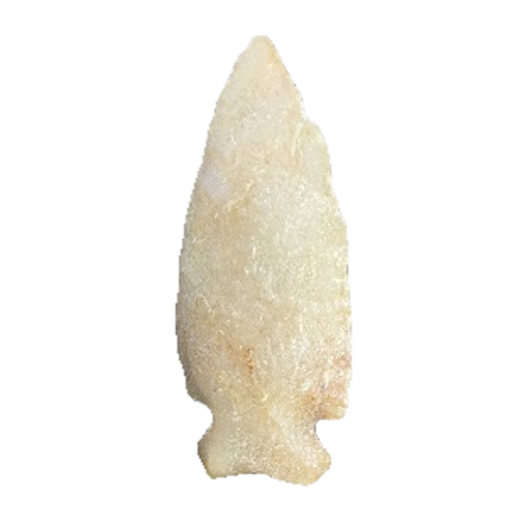
Arrowhead type
Turin Point
TurinLarge Side Notch Cluster8,000 - 7,500 B.P.Early Archaic10 reference photos
Key facts
- Age
- 8,000 - 7,500 B.P.
- Cultural period
- Early Archaic
- Size
- Medium
- Shape
- Side Notch
- Glacial period
- Middle Holocene
More from the Archaic period
Description
This triangular point exhibits a distinctive side notch configuration, characterized by a medium-sized triangular form and an elliptical cross-sectional profile. The blade's curvature is outward, displaying an excurvate shape. Notches are oriented diagonally, entering the blade at a low point to form a shoulder with a subtle, barbed morphology that transitions to a horizontal orientation. The stem's shape varies from expanded to expanding, while the base is concave, often presenting an auriculate appearance in many specimens. Evidence of grinding is visible in the basal and hafting regions, and the overall flaking pattern appears random.
Size
The dimensions of the arrowheads are characterized by the following measurements: overall length ranges from 20 to 90 mm, while the stem length spans 10 to 16 mm. The blade width varies between 19 and 33 mm, and the neck width falls within the range of 13 to 22 mm. Additionally, the stem width is measured between 16 and 26 mm, with these values being determined from a limited dataset.
Distribution
This type is mainly discovered in the western regions of Iowa, extending into Nebraska, Kansas, and Minnesota. It also appears in Illinois and Wisconsin, albeit with lesser occurrence.
Additional information
In the realm of Native American arrowhead typology, the Turin and Simonsen points are often conflated as a single entity in certain scholarly works. However, a closer examination reveals distinct characteristics that set them apart. The Simonsen point is notable for its side-notched configuration, where the notches enter the blade in a parallel fashion, relatively low on the point, and are accompanied by a straight base. In contrast, the Turin point exhibits diagonal notches that originate from the corners or just above the corners of the preform, resulting in a shoulder with a subtle barbed shape and a longer, expanding stem that terminates in a concave base.
The classification of these point types is further complicated by the existence of similar forms, which are often regarded as variations of the same type or as part of a continuum. The Turin point, in particular, is frequently combined with the Simonsen in the literature, despite the notable difference in notch orientation. As Morrow (1984) astutely observed, the Simonsen point bears a strong resemblance to the Little Sioux point, found in Iowa, suggesting that they may be one and the same. Similarly, other researchers have noted a correspondence between the Simonsen point and the Long Creek point, which originates from Saskatchewan. Interestingly, the Long Creek point is often considered synonymous with the Oxbow point, highlighting the complex and nuanced nature of these typological classifications.
A chronological analysis of these point types reveals a potential sequence of development, with the Turin point, dating to the Early Archaic period, potentially giving rise to the Simonsen/Little Sioux point, which spans the Early to Middle Archaic period. This, in turn, may have evolved into the Long Creek/Oxbow point, characteristic of the Middle Archaic period. By examining the temporal relationships between these point types, researchers can gain a deeper understanding of the technological and cultural trajectories of the indigenous populations that created them, shedding light on the dynamic and evolving nature of Native American arrowhead technology.
Identified by
- Named by
- Toby Morrows
- Year
- 1984
- Type site
- Turin Site, Monona County, Iowa
Similar types
Types that are easy to confuse with the Turin point.
Other types in the Large Side Notch Cluster
- Big Sandy
- Cache River
- Greenbrier
- Howard County
- Madison Side Notched
- Osceola Greenbrier