
Arrowhead type
Grand Point
GrandSnyders Cluster3,100 - 1,700 B.P.Late Archaic to Woodland5 reference photos
Key facts
- Age
- 3,100 - 1,700 B.P.
- Cultural period
- Late Archaic to Woodland
- Size
- Medium
- Shape
- Corner Notch to Side Notch
- Glacial period
- Neoglacial to Roman Warm
Description
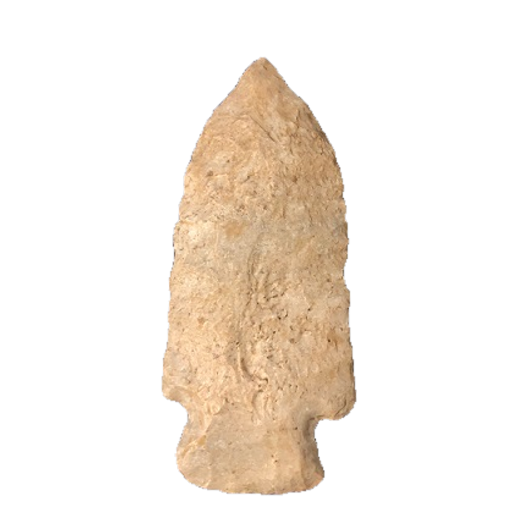
This triangular corner notch point exhibits a distinctive elliptical profile, with a blade that curves outward in a gentle, excurvate sweep. Notably compact and broad, the blade is complemented by barbed shoulders that expand into a sturdy stem. The convex base often displays a characteristic "dovetail" shape, achieved through the removal of thin, longitudinal flakes that frequently span the length of the stem. Evidence of meticulous hafting preparation is evident in the subtle grinding present on the hafting region. The point's fabrication involves an initial phase of broad percussion flaking, followed by a secondary stage of fine pressure flaking that refines the edges, yielding a random, intricate flaking pattern.
Size
The arrowheads exhibit the following dimensional characteristics: overall length ranges from 45 to 84 mm, with a mean length typically falling between 55 and 65 mm. The stem measures between 11 and 16 mm in length. The blade width varies from 25 to 45 mm, averaging between 33 and 38 mm. Additionally, the neck width spans 15 to 25 mm, while the stem width is between 23 and 33 mm.
Distribution
This type is predominantly discovered in Missouri and extends into eastern Oklahoma, northern Arkansas, and reaches into Illinois
Also found, less often, in
Additional information
In his 1987 analysis, Justice observed a notable morphological affinity between this particular point and the Snyders Cluster, suggesting that it is, in fact, a member of this cluster. The temporal context in which this point was utilized further reinforces its correlation with other points within the Snyders Cluster. A key distinction, however, is that this point does not exhibit cultural associations with the Hopewell culture, which is typically linked to many of the points found within this cluster, as noted in reference W11. This anomaly highlights the complexity and diversity of archaeological record, underscoring the need for nuanced interpretation of cultural and temporal contexts.
The Snyders Cluster, characterized by a distinct set of morphological traits, is generally dated to a specific time frame, during which this point is believed to have been used. The correlation between this point and other members of the Snyders Cluster is rooted in its shared morphological characteristics, which are consistent with the cluster's defining features. Despite its morphological similarities, however, this point's cultural context diverges from that of the Hopewell culture, which is commonly associated with many points within the cluster. This discrepancy serves as a reminder that cultural associations can be complex and multifaceted, and that points within a given cluster may exhibit diverse cultural affiliations.
The identification of this point as a member of the Snyders Cluster, yet distinct from the Hopewell culture, contributes to a deeper understanding of the archaeological record and the cultural dynamics at play during this time period. By examining the morphological and cultural characteristics of this point in relation to other members of the Snyders Cluster, researchers can gain valuable insights into the technological, social, and cultural developments of the societies that created these artifacts. As such, this point serves as an important component of the broader archaeological narrative, highlighting the complexity and richness of Native American cultural heritage.
Identified by
- Named by
- David Baerreis and John Freeman
- Year
- 1959
- Type site
- Multiple sites along the Grand River, northeastern Oklahoma
Similar types
Types that are easy to confuse with the Grand point.