
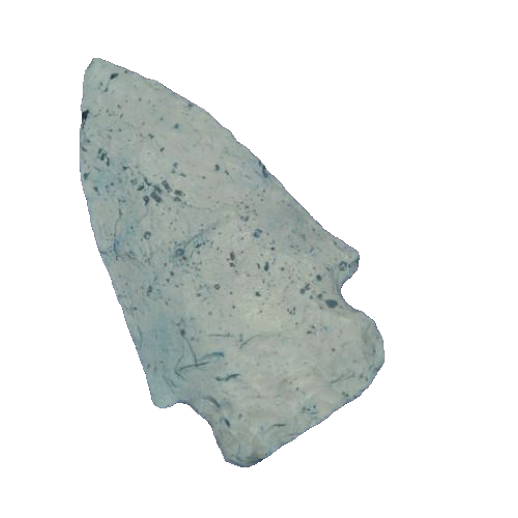
Arrowhead type
Helton Point
Helton6,000 - 4,500 B.P.Middle Archaic12 reference photos
Key facts
- Age
- 6,000 - 4,500 B.P.
- Cultural period
- Middle Archaic
- Culture
- Helton Culture
- Size
- Medium
- Shape
- Corner Notch to Side Notch to Expanding Stem
- Glacial period
- Neoglacial
More from the Archaic period
Description
This medium-sized, triangular point features a distinctive elliptical profile and a robust construction. Its blade exhibits a broad, sweeping form that can range from gently excurvate to straight-edged, offering versatility in its shape. The shoulders of the point are characterized by a subtle variation, spanning from a horizontal alignment to a slightly barbed configuration. The stem, which expands in width, terminates in a base that is either straight or subtly convex. The flaking pattern observed on this point is random, lacking a discernible, organized sequence.
Size
The dimensions of the arrowheads are as follows: they range in overall length from 45 to 75 mm, with stem lengths spanning 10 to 15 mm. The blade width varies between 25 and 38 mm, while the neck width measures between 16 and 24 mm. Additionally, the stem width is recorded to be between 19 and 27 mm.
Distribution
This type is mainly discovered in the central Mississippi River region and extends into the Illinois River Valley, southern Ohio River Valley and Iowa River valley. This type has also been identified in Nebraska and Kansas
Also found, less often, in
Additional information
In 1971, Houart pioneered the identification of a distinct arrowhead type, which was initially characterized through the analysis of specimens unearthed at the Koster site. However, a subsequent re-examination of these points by Cook in 1976 led to a significant reclassification. Cook's evaluation resulted in the categorization of the previously termed Helton points as Matanzas points, with the distinction of five notable variations within the Matanzas point category. Despite this reclassification, the term "Helton type" still appears in professional discourse, although some researchers have adopted Cook's classification, effectively superseding the use of the Helton designation. This dual nomenclature reflects the evolving nature of archaeological taxonomy, as our understanding of these ancient artifacts continues to refine and expand.
The Koster site, a pivotal location for this discovery, has provided invaluable insights into the technological and cultural developments of Native American communities. The Matanzas points, now recognized as a distinct entity with five variations, underscore the complexity and diversity of arrowhead designs crafted by these ancient cultures. By examining the characteristics and distribution of these points, researchers can glean a deeper understanding of the social, economic, and environmental contexts in which they were created and utilized.
The reclassification of Helton points as Matanzas points, as proposed by Cook, highlights the importance of ongoing scholarly review and refinement in the field of archaeology. As new evidence emerges and analytical techniques improve, our comprehension of the past becomes increasingly nuanced, allowing for a more accurate and detailed reconstruction of the lives and traditions of Native American communities. The study of arrowheads, such as the Matanzas points, serves as a testament to the ingenuity and craftsmanship of these ancient cultures, offering a window into their technological, artistic, and spiritual practices.
Identified by
- Named by
- Gail T. Houart
- Year
- 1971
- Type site
- Koster Site, Illinois
Similar types
Types that are easy to confuse with the Helton point.
- Apple Creek
- Delphi
- Kay Blade
- Lehigh
- Lundy
- Motley