
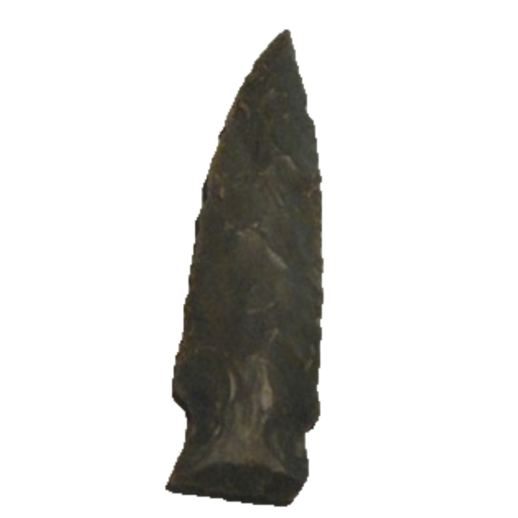
Arrowhead type
Bakers Creek Point
Bakers CreekLowe Cluster to Steuben Cluster2,500 - 1,200 B.P.Woodland14 reference photos
Key facts
- Age
- 2,500 - 1,200 B.P.
- Cultural period
- Woodland
- Size
- Small to Medium
- Shape
- Expanding Stem
- Material
- Flint
- Glacial period
- Roman Warm to Vandal Minimum
More from the Woodland period
Description
This triangular point measures between 1.25 and 1.75 inches in length, characterized by a stemmed to expanding stem morphology and a flattened cross-sectional profile. The blade exhibits a predominantly straight edge, culminating in a sharp, well-defined tip. The stem is notably elongated, with a subtle expansion towards the base, which can vary from a straight to a slightly convex configuration. The flaking pattern observed on this point is random, lacking a discernible or consistent pattern.
Size
The dimensions of the arrowheads are as follows: they range in length from 25 to 78 mm, with a typical average length of 45 to 55 mm. The stem length varies between 10 and 18 mm, averaging between 12 and 15 mm. The width of the blade spans 13 to 28 mm, with an average of 21 mm. The neck width measures between 14 and 22 mm, while the stem width ranges from 21 to 32 mm, averaging 23 mm. In terms of thickness, the arrowheads are between 7 and 10 mm.
Distribution
This projectile is mainly discovered in the Tennessee River Valley and extending into the Ohio River Valley of western Kentucky. Occurrence dwindles beyond this territory in the designated zones
Mainly found in
Also found, less often, in
Additional information
The archaeological record reveals that this particular cluster of arrowheads was predominantly utilized during the middle to late Woodland period, a timeframe that witnessed significant cultural and technological developments among Native American communities. Notably, these points succeeded the large corner notch points, commonly referred to as Snyders, and were later superseded by a range of other point styles, including Jacks Reef, Intrusive Mound, Knight Island, and Raccoon Creek points, as documented by Justice in 1987. This sequence of technological and stylistic evolution underscores the dynamic nature of prehistoric tool production and use.
Interestingly, similar arrowhead styles have been identified in other regions, including Florida, where they were designated as Taylor points for the smaller specimens and Broward points for the larger ones by Bullen, as referenced in Schroder's 2013 publication (W18). The presence of analogous point styles across different geographic areas, such as the Ohio River Valley and the Mississippi River Valley, highlights the extensive networks of cultural exchange and technological diffusion that existed among prehistoric societies. In these regions, points like Steuben, Lowe, and Chesser have been discovered, demonstrating a shared technological heritage and stylistic affinity with the points in question.
The study of these arrowhead clusters offers valuable insights into the lives and traditions of Native American communities during the Woodland period. By examining the morphological characteristics, distribution, and chronological context of these points, researchers can reconstruct the complex patterns of cultural interaction, migration, and technological innovation that shaped the prehistoric landscape of North America. Furthermore, the analysis of these artifacts underscores the importance of considering the broader cultural and historical context in which they were created and used, ultimately enriching our understanding of the rich and diverse heritage of Native American societies.
Identified by
- Named by
- David DeJarnette
- Year
- 1962
- Type site
- Cambron Site 53 (Bakers Creek Site), on Bakers Creek, Morgan County, Alabama
Similar types
Types that are easy to confuse with the Bakers Creek point.