
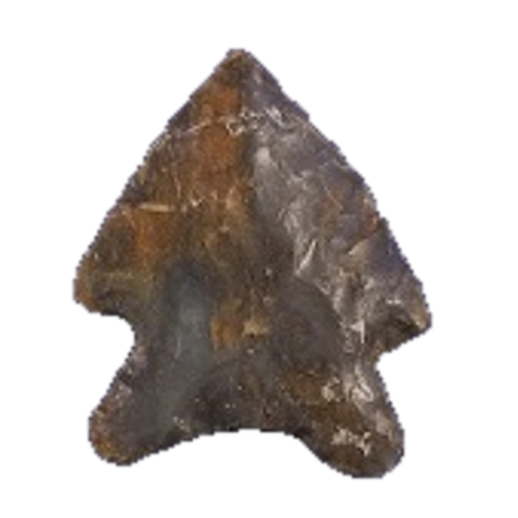
Arrowhead type
Edgewood Point
Edgewood3,000 - 1,500 B.P.Transitional Archaic to Early Woodland6 reference photos
Key facts
- Age
- 3,000 - 1,500 B.P.
- Cultural period
- Transitional Archaic to Early Woodland
- Size
- Small to Medium
- Shape
- Expanding Stem to Corner Notch
- Material
- Pottery
- Glacial period
- Neoglacial to Roman Warm
Description
This triangular point features a distinctive elliptical profile and a compact to medium size. Its blade length is relatively short, with a shape that can range from straight to gently curved outward. Notable beveling may be present on one or both edges of the blade. The shoulders are well-defined, often displaying a pronounced barb or an upward inclination. Characteristically, the stem broadens outward, with its base typically matching the width of the shoulders. The basal edge is commonly concave, although it can vary to nearly straight. The flaking pattern on this point is random, lacking a consistent or organized arrangement.
Size
The dimensions of the arrowheads are characterized by a length range of 30 to 50 mm. The stem, which constitutes approximately one-third to one-half of the overall length, measures between 13 and 17 mm. In terms of width, the arrowheads span 20 to 30 mm, with the stem width specifically ranging from 15 to 20 mm, as outlined by Suhm and Krieger (1954).
Distribution
This type is mainly located in the southeast region of Oklahoma, the southwest area of Arkansas, the western part of Louisiana, and the northeast section of Texas. Occurrence decreases in the central area of Texas. It is seldom discovered in the southern part of Texas, northeast Coahuila, north Nuevo Leon, and north Tamaulipas
Additional information
In the realm of Native American arrowhead typology, the Edgewood point presents a notable challenge in terms of differentiation, particularly from its counterpart, the Fairland type. Both types exhibit similar geographical distribution patterns and temporal frameworks, which can lead to difficulties in distinguishing between them. A key characteristic that has been used to differentiate Edgewood points is their size, typically ranging from 30 to 50 mm in length, whereas Fairland points tend to be larger, measuring between 41 to 70 mm in length. Despite this size discrepancy, Edgewood points are generally broader than Fairland points, given their comparable widths.
The complexity of distinguishing Edgewood points from other types, including Fairland, Bandy, and Martindale, is a subject of ongoing discussion among archaeologists. The seminal work of Suhm and Krieger (1954) highlights this challenge, as their examples of Edgewood points (illustrated in plate 88) may, in fact, include Fairland points, and vice versa, with Fairland points (depicted in plate 91) potentially encompassing Edgewood points. This overlap underscores the blurred lines between these typological categories, raising questions about the distinctiveness of the Edgewood type. It is conceivable that the Edgewood classification may serve as a catchall for outliers that do not neatly fit into the Bandy, Martindale, or Fairland categories, rather than representing a discrete, well-defined type in its own right.
The Edgewood point's ambiguous status as a distinct type warrants further examination and refinement of its defining characteristics. As archaeologists continue to study and compare these points, it is essential to consider the broader context of Native American arrowhead typology, acknowledging the complexities and nuances that underlie our understanding of these ancient artifacts. By doing so, we can work towards a more nuanced comprehension of the Edgewood point's place within the larger landscape of Native American material culture, and the ways in which it may relate to, or diverge from, other point types, such as Fairland, Bandy, and Martindale.
Identified by
- Named by
- Dee Ann Suhm
- Year
- 1954
Similar types
Types that are easy to confuse with the Edgewood point.