
Arrowhead type
Flint Creek Point
Flint Creek3,000 2,100 B.P.Early Archaic13 reference photos
Key facts
- Age
- 3,000 2,100 B.P.
- Cultural period
- Early Archaic
- Size
- Medium to Large
- Shape
- Straight Stem to Expanding Stem
- Material
- Flint
- Glacial period
- Neoglacial to Roman Warm
More from the Archaic period
Description
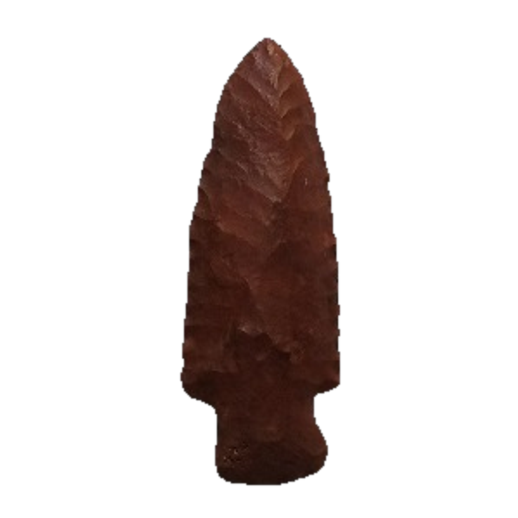
This triangular point exhibits a robust profile, measuring between 1.5 to 3 inches in length, with a distinctive elliptical cross-sectional shape. The blade itself is characterized by a narrow, outwardly curved (excurvate) shape, often featuring fine serrations along its edges. The shoulders of the point are generally oriented horizontally, although some specimens may display a subtle, upward inclination or a barbed morphology. The stem, which expands in width, may show evidence of grinding in the area where it would have been attached to a haft. The base of the point typically presents a convex shape, sometimes with a pronounced, bulbous appearance, although a straight base is also occasionally observed. In some cases, the base may exhibit light grinding or thinning, and remnants of cortex may be preserved in this area. The flaking pattern on this point is random, lacking a consistent or deliberate pattern.
Size
The dimensions of the arrowheads are as follows: they typically range in overall length from 39 to 76 mm, with a mean length of 55 mm. The stem section measures between 7 and 15 mm in length, averaging 11 mm. The blade itself spans a width of 18 to 29 mm, with an average width of 23 mm. The stem width varies from 13 to 19 mm, averaging 16 mm. In terms of thickness, the arrowheads measure between 7 and 12 mm.
Distribution
This type is mainly discovered in upper Alabama and extending into middle Tennessee, upper Alabama, and south-western Georgia
Mainly found in
Also found, less often, in
Additional information
In the realm of Native American arrowhead typology, a particular point of interest exhibits characteristics that may be considered an extension of the Pontchartrain type. Notably, this point distinguishes itself through its expanding stem, a feature that diverges from the typical Pontchartrain points, which are generally characterized by straight or slightly contracting stems. This observation is supported by research conducted by MaGahey in 2000, highlighting the subtle yet significant variations within arrowhead types. The presence of an expanding stem in this point suggests a potential sub-type or regional variation, warranting further examination to fully understand its cultural and chronological context.
The distinction between the expanding stem of this point and the straight or contracting stems of the Pontchartrain type underscores the complexity and nuance of Native American arrowhead classification. Archaeologists must consider multiple factors, including stem morphology, when categorizing and analyzing these artifacts. By recognizing and interpreting such variations, researchers can gain valuable insights into the technological, social, and cultural practices of the societies that created these arrowheads.
Further study of this point and its potential relationship to the Pontchartrain type may shed light on the evolutionary trajectories of arrowhead designs, as well as the exchange networks and cultural interactions that influenced the development of these technologies. As researchers continue to refine their understanding of Native American arrowhead typology, the identification of subtle variations, such as the expanding stem in this point, will remain essential for reconstructing the histories and cultural practices of the communities that crafted these artifacts.
Identified by
- Named by
- James Cambron
- Year
- 1958
- Type site
- Cambron Site 78, Flint Creek, Morgan County, Alabama
Similar types
Types that are easy to confuse with the Flint Creek point.