
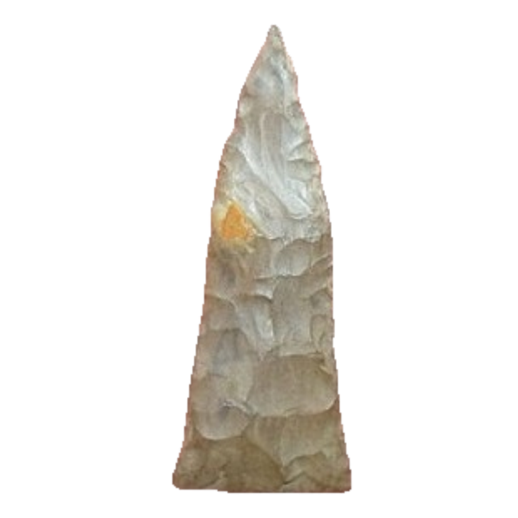
Arrowhead type
Copena Triangular Point
Copena TriangularCopena Cluster4,000- 1,500 B.P.Late Archaic to Woodland6 reference photos
Key facts
- Age
- 4,000- 1,500 B.P.
- Cultural period
- Late Archaic to Woodland
- Culture
- Copper Burial Mound Culture
- Size
- Medium to Large
- Shape
- Triangle
- Material
- Pottery
- Glacial period
- Neoglacial to Roman Warm
Description
This lanceolate point exhibits a medium to large size profile, characterized by an elliptical cross-sectional shape. The blade morphology is predominantly excurvate, although it may transition to a straighter configuration in the vicinity of the hafting area. In certain instances, the blade above the hafting area may maintain a straight alignment, while in other cases, one blade edge may display excurvate curvature, contrasting with a straight edge on the opposing side. The base of the point is generally straight, but may occasionally exhibit a subtle concavity, accompanied by evidence of grinding or thinning. Basal flaking patterns can vary, ranging from short, isolated flakes to longer flakes that extend along the length of the hafting area. Overall, the flaking pattern on this point appears to be random, lacking a consistent or organized arrangement.
Size
The arrowheads exhibit a range of dimensions, with total lengths spanning from 30 to 74 mm, and averaging between 35 to 55 mm. The basal width ranges from 19 to 31 mm, with a mean width of 25 mm. In terms of thickness, the arrowheads measure between 7 to 10 mm.
Distribution
This type is mainly located in the Tennessee River Valley. It can also be discovered in the Ohio River Valley, the central Mississippi River valley and the southeastern coastal area
Mainly found in
Also found, less often, in
Additional information
The Copena culture is predominantly linked to the northern region of Alabama, where its distinctive characteristics have been extensively documented. Notably, this culture is renowned for its burial artifacts, which frequently feature copper and galena, thereby lending its name to the culture. The term "Copena" is a direct reference to the presence of these specific materials, namely copper (cop) and galena (ena), in the funerary context.
In a notable development, John Whatley (2002) introduced the designation "Florida Copena" to describe the Copena-type points discovered in southern Georgia and extending into Florida. A striking aspect of these points is their relatively smaller size compared to their counterparts found in areas north of this region. This size discrepancy suggests potential regional variations in the manufacture and use of Copena-type points, underscoring the complexity and diversity of this cultural phenomenon.
The Copena culture's geographic distribution and material characteristics offer valuable insights into the lives and traditions of its people. The presence of copper and galena in burial contexts implies a level of cultural and technological sophistication, as well as a possible emphasis on spiritual or ceremonial practices. Furthermore, the variation in point size across different regions may indicate distinct functional or stylistic preferences, highlighting the need for continued research and analysis to fully understand the nuances of Copena culture and its significance within the broader context of Native American archaeology.
Identified by
- Named by
- William Webb and David DeJannette
- Year
- 1942
- Type site
- Pickwick Basin, northern Alabama
Similar types
Types that are easy to confuse with the Copena Triangular point.
Other types in the Copena Cluster
- Copena Articulated
- Copena Round Base
- Copena