
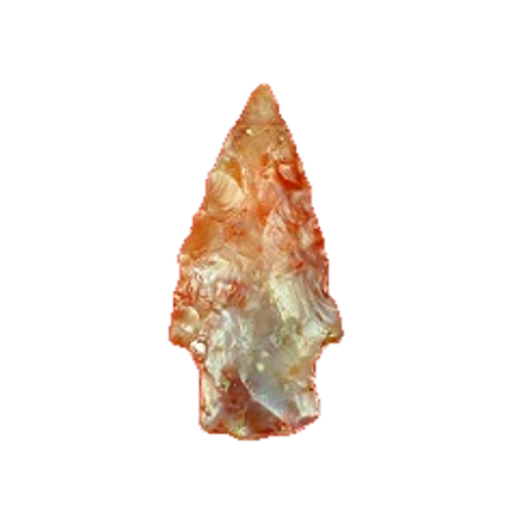
Arrowhead type
Swan Lake Point
Swan LakeLowe Cluster to Steuben Cluster2,000 - 1,500 B.P.Late Archaic to Early Woodland9 reference photos
Key facts
- Age
- 2,000 - 1,500 B.P.
- Cultural period
- Late Archaic to Early Woodland
- Size
- Small
- Shape
- Expanding Stem to Straight Stem
- Material
- Quartz
- Glacial period
- Roman Warm
Description
This triangular point exhibits a distinctive morphology, characterized by an expanding stem and a cross-sectional profile that ranges from elliptical to median ridged. The blade edge can vary in curvature, spanning from excurvate to straight. Notable features include wide, parallel notches that are relatively shallow, forming a shoulder with an upward inclination and merging into an expanding stem. The basal edge is often straight, although it can also be slightly convex or concave, and may remain unfinished, retaining remnants of the original rind. In some instances, subtle basal grinding is evident. The flaking pattern on this point is random, and the overall craftsmanship is often crude, suggesting a hurried or unrefined manufacturing process. Dimensions of this point typically fall within a compact range, measuring between 0.75 and 1.5 inches in length.
Size
The arrowheads exhibit the following dimensional characteristics: - Overall length ranges from 25 to 41 mm, with a mean length of 31 to 38 mm. - The stem length varies between 8 and 14 mm, averaging 10 to 11 mm. - Blade width measurements fall within the 12 to 20 mm range, with an average width of 15 to 17 mm. - At the shoulder, the stem width is between 10 and 17 mm, averaging 14 to 16 mm. - Basal width ranges from 13 to 19 mm, with an average of 16 to 17 mm. - The thickness of the arrowheads is measured at 5 to 9 mm.
Distribution
This type is mainly located in the Tennessee River Valley region.
Mainly found in
Additional information
The emergence of a particular point style, as noted by Cambron in 1975, is believed to have occurred during the Late Archaic period, with its popularity peaking in the early Woodland period. Notably, these points bear a resemblance to the Jackson points commonly found in the Gulf Coastal regions of Georgia and Florida, as observed by Schroder in 2011. A comparative analysis by Whatley in 2002 reveals that Swan Lake points and Coosa Notched points share numerous characteristics, suggesting a close relationship between the two. Whatley proposes that these point styles could be considered together, with the Coosa Notched points, which are slightly larger, being associated with the late Early to Middle Woodland period, and the smaller Swan Lake points being exclusive to the Middle Woodland period.
A distinguishing feature of Coosa Notched points is their more convex base, which sets them apart from Swan Lake points. Additionally, the asymmetrical blade shape and larger size of Coosa Notched points further differentiate them from their Swan Lake counterparts. This distinction is crucial in understanding the developmental trajectory of these point styles and their cultural significance. The similarities and differences between Swan Lake and Coosa Notched points highlight the complexities of point style evolution and the need for nuanced analysis in archaeological research.
The study of these point styles provides valuable insights into the technological and cultural developments of Native American communities during the Woodland period. By examining the characteristics and distribution of these points, researchers can reconstruct the social, economic, and environmental contexts in which they were created and used. The work of Cambron, Schroder, and Whatley has significantly contributed to our understanding of these point styles, and continued research in this area will undoubtedly shed further light on the lives and traditions of Native American communities in the region.
Identified by
- Named by
- James W. Cambron and David Hulse
- Year
- 1960
Similar types
Types that are easy to confuse with the Swan Lake point.