
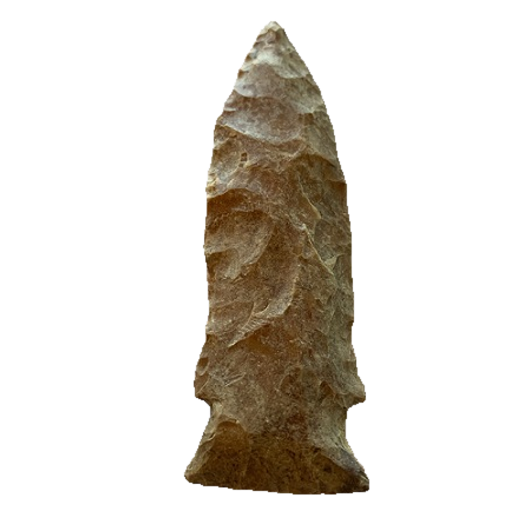
Arrowhead type
Lowe Point
LoweLowe Cluster to Steuben Cluster1,800 - 1,400 B.P.Late Archaic20 reference photos
Key facts
- Age
- 1,800 - 1,400 B.P.
- Cultural period
- Late Archaic
- Culture
- LeMotte Culture
- Size
- Large
- Shape
- Straight Stem to Expanding Stem
- Glacial period
- Roman Warm
More from the Archaic period
Description
This medium-sized point exhibits an elliptical profile, with a blade that varies in curvature from excurvate to straight. The shoulders display a range of morphologies, from subtly barbed to angled upwards. A beveled edge is a common feature of the blade. The stem, which expands in width, has straight sides and often displays beveling along its edges and base. In some cases, grinding may also be present on these surfaces. The base of the point can be either straight or slightly convex in shape. The flaking pattern observed on this point is random, lacking a consistent or organized arrangement.
Size
The dimensions of the arrowheads are as follows: they range in total length from 36 to 110 mm, with stem lengths varying between 10 and 17 mm. The blade width spans 17 to 33 mm, averaging 22 mm. Additionally, the neck width measures between 13 and 22 mm, while the stem width falls within the range of 16 to 33 mm. In terms of thickness, the arrowheads are between 4 and 9 mm.
Distribution
This type is predominantly found in the southern Wabash region and the Ohio River basin (encompassing southern Illinois, southern Indiana, western Kentucky, and western Tennessee)
Additional information
The archaeological record reveals that this particular cluster of arrowheads was predominantly utilized during the middle to late Woodland period, a timeframe that witnessed significant cultural and technological developments among Native American communities. Notably, these points succeeded the large corner notch points, such as the Snyders type, and were subsequently superseded by a range of other point styles, including Jacks Reef, Intrusive Mound, Knight Island, and Raccoon Creek, as documented by Justice in 1987.
A key distinguishing feature between two specific types of arrowheads, the Allison and the Lowe, is the angle of the blade, as astutely observed by Stephens in 1975. Upon closer examination, it becomes apparent that the blade angle of these points can be discerned by drawing an imaginary line along the stem edges. In the case of the Lowe type, this line would intersect at the tip of the point, whereas for the Allison type, the line would converge at the center of the blade. This subtle yet significant difference in blade angle underscores the importance of meticulous analysis in identifying and categorizing arrowhead types, ultimately shedding light on the technological and cultural nuances of Native American societies during this period.
The careful study of these arrowhead types not only provides valuable insights into the lives and traditions of Native American communities but also highlights the dynamic nature of technological innovation and cultural exchange during the Woodland period. By examining the morphological characteristics of these points, such as the angle of the blade, researchers can reconstruct the complex historical narratives of these societies, gaining a deeper understanding of their technological, social, and cultural developments over time. As such, the analysis of arrowhead types like the Allison and Lowe serves as a testament to the richness and diversity of Native American cultural heritage, inviting further exploration and discovery.
Identified by
- Named by
- Howard D Winters
- Year
- 1963
- Type site
- Multiple sites in the lower Wabash Valley, Illinois
Similar types
Types that are easy to confuse with the Lowe point.
- Delphi
- Epps
- Harpeth River
- Rice Shallow Notch
- Table Rock