
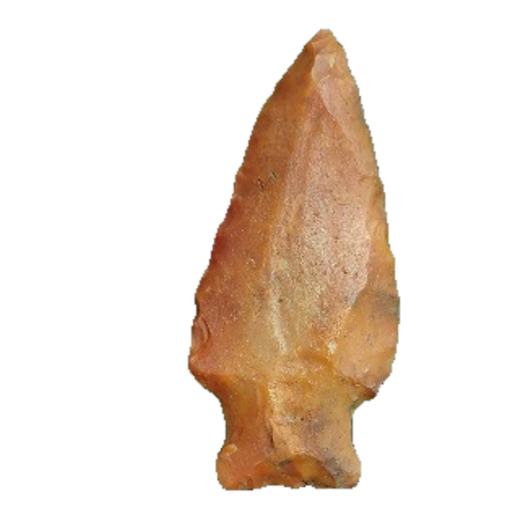
Arrowhead type
Bradford Point
Bradford1,900 - 1,200 B.P.Middle Archaic2 reference photos
Key facts
- Age
- 1,900 - 1,200 B.P.
- Cultural period
- Middle Archaic
- Size
- Medium
- Shape
- Straight Stem to Expanding Stem
- Glacial period
- Roman Warm to Vandal Minimum
More from the Archaic period
Description
This triangular projectile point exhibits a medium size range, measuring between 1.5 and 2.75 inches in length. Its cross-sectional shape is elliptical, providing a stable foundation for the blade. The blade's profile is predominantly excurvate, although some specimens may display a straight alignment. The shoulders of the point are typically angled upward, yet can also be found at a horizontal orientation. The stem's morphology varies from expanding to slightly expanding, accompanied by a base that can be either straight or convex. The flaking pattern observed on this point is random, indicating a lack of deliberate, organized flaking technique.
Size
The dimensions of the arrowheads are characterized by the following measurements: overall length ranges from 34 to 75 mm, with a typical average length of 45 to 55 mm. The stem segment measures between 12 to 18 mm in length, while the blade itself spans 18 to 35 mm in width. The stem width is recorded as 15 to 22 mm, and the thickness of the arrowhead varies from 6 to 10 mm.
Distribution
This type is mainly located in upper Florida and extending into lower Georgia and middle Florida
Also found, less often, in
Additional information
In the realm of Native American arrowhead studies, the Jackson point is considered a distinct variant that shares a common lineage with other types. Notably, its geographic distribution mirrors that of its counterparts, and it is culturally affiliated with the same indigenous groups. A closer examination of the Jackson point reveals a plethora of characteristics that are reminiscent of its related types, as observed by Granger and Granger in their 2013 research. This similarity in form and function suggests a shared technological and stylistic heritage, underscoring the complex and nuanced nature of arrowhead typology.
The Jackson point's association with a specific cultural context is a significant aspect of its archaeological significance. By analyzing the distribution and characteristics of this point type, researchers can gain valuable insights into the technological, social, and economic dynamics of the cultures that created and utilized them. The fact that the Jackson point is linked to the same cultural groups as other related types implies a level of continuity and exchange between these communities, highlighting the importance of considering the broader cultural landscape in which these artifacts were crafted and used.
Further study of the Jackson point and its counterparts can provide a more comprehensive understanding of the evolutionary trajectories of Native American arrowhead technology, as well as the cultural and historical contexts in which they were developed. By exploring the similarities and differences between these point types, researchers can refine their understanding of the complex and dynamic processes that shaped the lives of indigenous peoples in North America, ultimately enriching our appreciation of the rich cultural heritage of these communities.
Identified by
- Named by
- Ripley P. Bullen
- Year
- 1968
Similar types
Types that are easy to confuse with the Bradford point.