
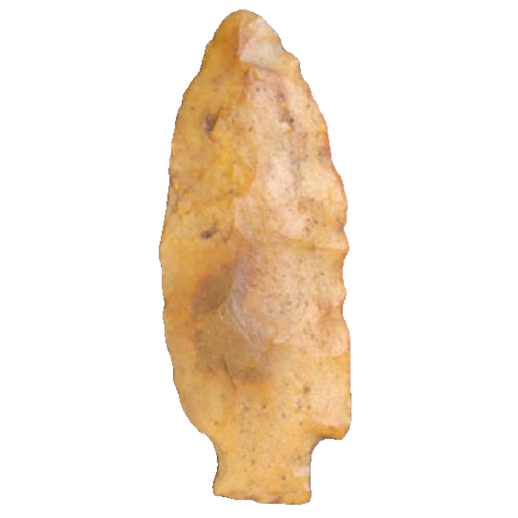
Arrowhead type
Broward Point
Broward2,100 - 800 B.P.Woodland to Mississippian6 reference photos
Key facts
- Age
- 2,100 - 800 B.P.
- Cultural period
- Woodland to Mississippian
- Size
- Medium to Large
- Shape
- Straight Stem to Expanding Stem to Basal Notch
- Glacial period
- Roman to Medieval
More from the Woodland, Mississippian periods
Description
This triangular point measures between 2.5 and 4 inches in length, characterized by an expanding stem. The blade exhibits a predominantly excurvate profile, with curvature varying along its length. In some instances, the blade maintains a consistent curve from the apex to the shoulder, while in others, it converges at the tip before becoming more parallel-edged, or alternatively, curves inward at the tip and then recurves toward the shoulders. The shoulders themselves may display a subtle barbing or a slight upward inclination. The stem's expanding nature is a notable feature, complemented by a base that is typically convex, although occasionally it may be slightly concave, with basal corners that are rounded. The flaking pattern observed on this point is random.
Size
The dimensions of the arrowheads are as follows: they typically range in overall length from 50 to 95 mm, with a mean length generally falling between 55 and 65 mm. In terms of blade proportions, the width spans 25 to 40 mm, while the thickness measures between 7 and 10 mm.
Distribution
This type is mainly located in Florida and extends into the southern regions of Georgia and Alabama.
Also found, less often, in
Additional information
In their 2013 publication, Granger and Granger identified four distinct variations of a particular Native American arrowhead type. A notable characteristic of these variations is the shape and size of the stem, which expands in width from the tip to the base. The first variation is distinguished by its broad, expanding stem, concave base, and rounded basal corners, forming a unique silhouette. In contrast, the second variation features a broad, expanding stem with a straight base and rounded basal corners, accompanied by moderately barbed shoulders that add to its distinctive appearance.
The third variation exhibits a moderately broad, expanding stem, but with a convex base and rounded basal corner, as well as slightly barbed shoulders. This subtle difference in basal shape and shoulder barbing sets it apart from the other variations. The fourth and final variation is characterized by a narrowed, expanding stem, a slightly concave base, and rounded basal corners, with slightly barbed shoulders that contribute to its overall morphology. These variations demonstrate a range of design and manufacturing choices made by the arrowhead's creators, highlighting the diversity and complexity of Native American lithic technology.
It is worth noting that the first variation of this arrowhead type bears a strong resemblance to the Gadsden type, as described by Bullen. This similarity suggests a potential cultural or geographical connection between the groups that produced these arrowheads, and underscores the importance of continued research and analysis to fully understand the context and significance of these artifacts. By examining the subtle differences and similarities between these variations, archaeologists can gain a deeper insight into the lives and traditions of the Native American communities that crafted them, and shed new light on the rich and complex history of the region.
Identified by
- Named by
- Ripley P. Bullen
- Year
- 1968
- Type site
- Peace Camp Site, Broward County, Florida
Similar types
Types that are easy to confuse with the Broward point.