
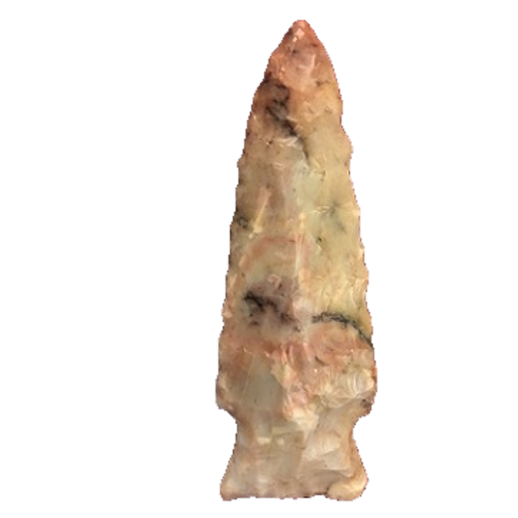
Arrowhead type
Chesser Point
ChesserLowe Cluster to Steuben Cluster1,600 - 1,200 B.P.Woodland12 reference photos
Key facts
- Age
- 1,600 - 1,200 B.P.
- Cultural period
- Woodland
- Size
- Medium
- Shape
- Expanding Stem
- Glacial period
- Roman Warm to Vandal Minimum
More from the Woodland period
Description
This projectile point exhibits a medium notched to expanding stem morphology, characterized by an elliptical cross-sectional profile. The blade itself is marked by a pronounced excurvate shape, with a broadly proportioned outline. The shoulder regions display a subtle variability, ranging from slightly barbed to shoulders that slope upward at a noticeable angle. The stem, which expands in width, provides a sturdy foundation, while the base presents a predominantly straight edge, albeit with occasional subtle deviations towards a convex or concave curvature. The flaking pattern observed on this point is random, lacking a discernible order or sequence.
Size
The arrowheads exhibit the following dimensional characteristics: their overall length ranges from 33 to 70 mm, with a typical average length of 45 to 55 mm. The stem portion measures between 10 to 18 mm in length, averaging 12 to 15 mm. The blade width varies from 13 to 32 mm, with an average width of 21 mm. The neck width is between 15 to 20 mm, while the stem width ranges from 15 to 32 mm, averaging 23 mm. In terms of thickness, the arrowheads measure between 7 to 10 mm.
Distribution
This type is mainly located in the middle and southern regions of Ohio, yet can also appear in southwestern New York, southwestern Pennsylvania, southwestern West Virginia, northeastern Kentucky, eastern Indiana, and southern Michigan (mid and upper Ohio River Valley and its surrounding drainage areas).
Also found, less often, in
Additional information
The archaeological record indicates that this particular cluster of arrowheads was predominantly utilized during the middle to late Woodland period, a timeframe that witnessed significant cultural and technological developments among Native American communities. Notably, these points emerged as a replacement for the earlier large corner notch points, commonly referred to as Snyders. As cultural and technological advancements continued, this cluster of arrowheads was eventually superseded by a range of other point styles, including Jacks Reef, Intrusive Mound, Knight Island, and Raccoon Creek points, as documented by Justice in 1987. This sequence of technological and stylistic evolution offers valuable insights into the dynamic nature of prehistoric tool development and the cultural exchange networks that existed among Native American groups during this period.
Identified by
- Named by
- Olaf Prufer
- Year
- 1967
- Type site
- Chesser Cave, Athens County, Ohio
Similar types
Types that are easy to confuse with the Chesser point.
- M
- ud Creek
- Norton