
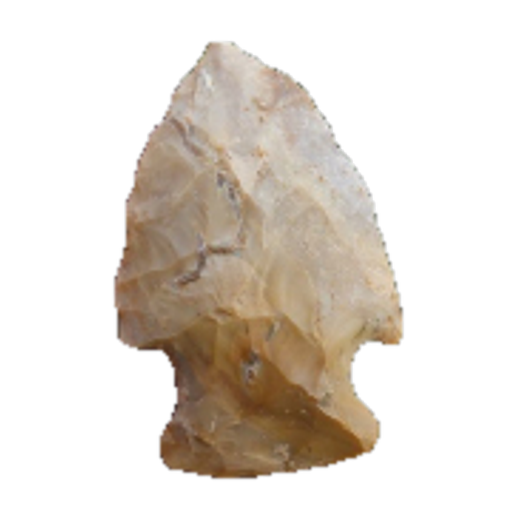
Arrowhead type
Ellis Point
Ellis3,800 - 1,700 B.P.Late Archaic to Early Woodland12 reference photos
Key facts
- Age
- 3,800 - 1,700 B.P.
- Cultural period
- Late Archaic to Early Woodland
- Size
- Small to Medium
- Shape
- Corner Notch to Side Notch
- Material
- Pottery
- Glacial period
- Neoglacial to Roman Warm
Description
This triangular projectile point exhibits a corner notch morphology, with a stem that broadens outward from the notch, never attaining the same width as the shoulder area. The cross-sectional profile is elliptical, while the blade edge oscillates between excurvate and straight configurations. The shoulders typically display a subtle barbing, although re-sharpening can result in a range of orientations, from horizontal to a slight, upward inclination. The basal edge is characterized by a straight to convex shape. Notably, the manufacture of this point type often appears expedient, with a non-patterned, random flaking pattern evident on its surface.
Size
The dimensions of the arrowheads are characterized by the following measurements: they range in length from 30 to 50 mm, with the stem length comprising approximately 12 to 25 mm, which is typically equivalent to one-quarter to one-half of the overall length. The width at the shoulders spans 20 to 30 mm, while the stem width measures between 15 to 20 mm, as outlined by Suhm and Krieger (1954).
Distribution
This type is mainly linked to the eastern Texas region (encompassing eastern Texas and extending into Arkansas, Louisiana, and Oklahoma). Its occurrence becomes less common in other specified zones.
Additional information
In the realm of archaeological classification, this particular point presents a notable challenge, as its characteristics can be easily conflated with those of the Edgewood and Zavala types. This similarity was first highlighted by Turner and Hester in their 1985 publication, which underscored the need for meticulous analysis in distinguishing between these closely related point styles. The overlap in characteristics between these types necessitates a thorough examination of morphological and technological attributes to accurately identify and categorize this point. By recognizing these similarities and differences, researchers can gain a deeper understanding of the cultural and historical contexts in which these points were crafted and utilized.
Identified by
- Named by
- Perry Newell and Alex D. Krieger
- Year
- 1949
- Type site
- George C. Davis Site, Cherokee County, Texas
Similar types
Types that are easy to confuse with the Ellis point.