
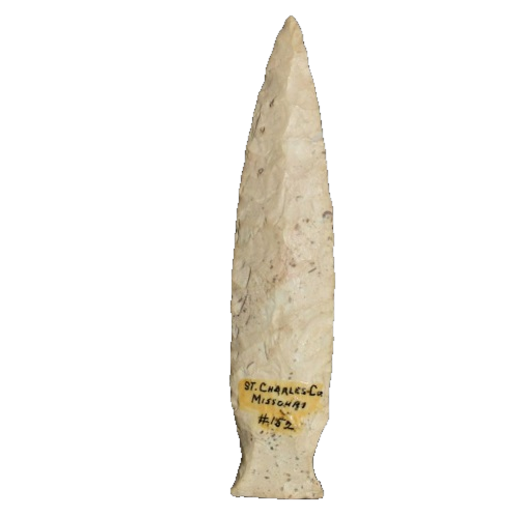
Arrowhead type
Steuben Point
SteubenLowe Cluster to Steuben Cluster1,700 - 1,400 B.P.Woodland19 reference photos
Key facts
- Age
- 1,700 - 1,400 B.P.
- Cultural period
- Woodland
- Size
- Small to Medium
- Shape
- Expanding Stem to Corner Notch
- Material
- Chert
- Glacial period
- Roman Warm
More from the Woodland period
Description
This medium-sized point features a stem with a broad, expanding profile and an elliptical shape in cross-section. The blade's curvature varies, transitioning from a pronounced excurvate shape to a straight edge. Characteristic parallel notches define the shoulders, which slope upward at a gentle to moderate angle. The base of the point is typically straight or slightly convex, often lacking evidence of basal grinding. The manufacturing technique employed random percussion flaking, supplemented by marginal pressure retouch that produced a random, irregular flaking pattern across the point's surface.
Size
The arrowheads exhibit the following dimensional characteristics: their overall length ranges from 30 to 78 mm, with a typical average length of 45 to 55 mm. The stem of the arrowhead measures between 10 to 18 mm in length, averaging between 12 to 15 mm. In terms of width, the blade spans 13 to 32 mm, with an average width of 21 mm. The neck width varies from 13 to 22 mm, while the stem width ranges from 15 to 32 mm, averaging 23 mm. The thickness of the arrowheads falls within the range of 7 to 10 mm.
Distribution
This type is predominantly found in Illinois, Missouri, eastern Iowa, southern Wisconsin, and extends into Minnesota and Indiana.
Additional information
The Steuben point cluster is a significant archaeological find, dating back to the middle to late Woodland period. This particular type of arrowhead emerged as a successor to the large corner notch points, commonly referred to as Snyders. Over time, Steuben points were eventually supplanted by other point styles, including Jacks Reef, Intrusive Mound, Knight Island, and Raccoon Creek, as noted by Justice in 1987. Notably, the characteristics of Steuben points exhibit a high degree of overlap with several other point types, including Bakers Creek, Chesser Notched, Lowe Flared-Base, Monona Stemmed, and McCoy Corner-Notched. This phenomenon has led some researchers to suggest that these various names may simply represent regional variations of the same fundamental point type, as argued by Morrow in 2016.
A closer examination of the Steuben point cluster reveals a complex web of similarities and differences with other point styles. Despite their shared characteristics, each of these point types possesses distinct features that set them apart from one another. The Steuben point, in particular, is marked by a unique combination of traits that reflect the cultural and technological contexts in which it was created. By studying these points and their relationships to other styles, archaeologists can gain valuable insights into the lives and traditions of the Native American communities that crafted them.
The significance of the Steuben point cluster extends beyond its own characteristics, as it provides a window into the broader cultural and historical landscape of the Woodland period. The evolution of point styles over time reflects the dynamic and adaptive nature of Native American cultures, as they responded to changing environmental, social, and technological conditions. As such, the study of Steuben points and their counterparts offers a rich and nuanced perspective on the lives and experiences of indigenous peoples in North America, highlighting the complexity and diversity of their cultural heritage.
Identified by
- Named by
- Dan F. Morse
- Year
- 1963
- Type site
- Steuben Site, Fulton County, Illinois
Similar types
Types that are easy to confuse with the Steuben point.
- Conrad
- Durst