
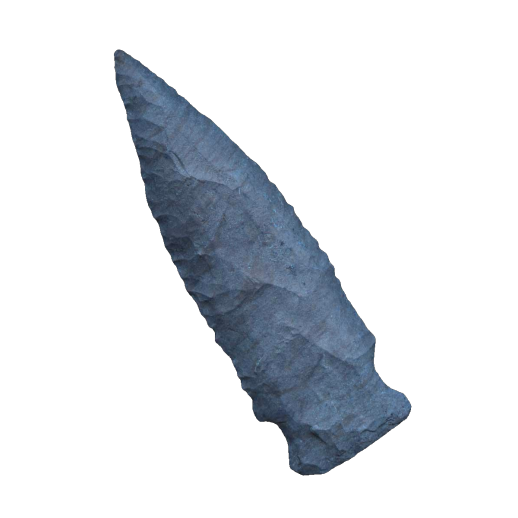
Arrowhead type
Harpeth River Point
Harpeth River11,000 - 8,500 B.P.Transitional Paleo to Early Archaic12 reference photos
Key facts
- Age
- 11,000 - 8,500 B.P.
- Cultural period
- Transitional Paleo to Early Archaic
- Size
- Medium to Large
- Shape
- Expanding Stem
- Glacial period
- Early Holocene
Description
This expanding stemmed point measures between 2.10 and 3.60 inches in length, characterized by a flattened cross-sectional profile. The blade morphology varies, exhibiting a range from excurvate to straight configurations, often accompanied by fine serrations. Both faces of the blade typically display beveling, with each edge carefully angled. The distal tip can range from acute to acuminate in shape. The shoulders are either weakly defined or absent, positioned at an upward angle, which results in a expansive hafting area. The stem is often marked by a shallow, wide side notch, expanding in width. The base of the point is generally straight, with evidence of basal grinding and thinning on the hafting region, indicating deliberate shaping for attachment. The flaking pattern on this point is random, lacking a consistent or organized arrangement.
Size
The dimensions of the arrowheads are as follows: they range in overall length from 53 to 90 mm, with a mean length of 67 mm. The stem length varies between 11 and 25 mm, averaging 16 mm. The blade width measures between 20 and 26 mm, with an average width of 23 mm. The stem width is recorded at two points: at the base, it ranges from 20 to 28 mm, averaging 25 mm, while at the shoulders, it narrows to a range of 16 to 24 mm, with an average of 21 mm. The thickness of the arrowheads is consistently between 8 and 10 mm.
Distribution
This type is mainly discovered in the Harpeth River Valley of northwest Tennessee and extending into southwest Kentucky
Additional information
In the realm of Native American arrowheads, a notable example is the Harpeth River Point, which typically does not exhibit fluting. However, an exception to this characteristic has been documented by Cambron in 1967, where a single instance of a fluted point was observed, crafted from a deliberately prepared platform designed to facilitate fluting. This unique feature sets it apart from the more commonly found non-fluted specimens.
A distinct variation of the Harpeth River Point is recognized as the Rockport Variation. This specific type has been thoroughly examined and described by Adair and Sims in their 1970 publication, "Rockport Variety, Harpeth River Point," which appeared in the Tennessee Archaeologist, Volume 26, Number 2, on pages 23-29. This detailed study provides valuable insights into the characteristics and significance of the Rockport Variation, offering a deeper understanding of the cultural and historical context in which these arrowheads were created.
The existence of the Rockport Variation highlights the diversity and complexity of Native American arrowhead craftsmanship, demonstrating the resourcefulness and adaptability of the cultures that produced these artifacts. By examining the variations and exceptions within point types, such as the fluted example noted by Cambron, archaeologists can gain a more nuanced understanding of the technological, social, and cultural factors that influenced the development of these ancient tools. As such, continued research and documentation of these artifacts remain essential for uncovering the rich history and cultural heritage of Native American communities.
Identified by
- Named by
- James Cambron
- Year
- 1970
Similar types
Types that are easy to confuse with the Harpeth River point.