
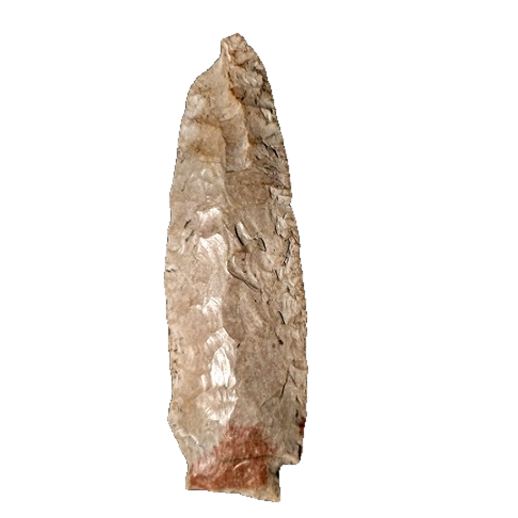
Arrowhead type
Columbia Point
ColumbiaLowe Cluster to Steuben Cluster1,800 - 850 B.P.Woodland12 reference photos
Key facts
- Age
- 1,800 - 850 B.P.
- Cultural period
- Woodland
- Culture
- Weeden Island Culture
- Size
- Medium to Large
- Shape
- Expanding Stem to Corner Notch
- Glacial period
- Roman to Medieval Warm
More from the Woodland period
Description
This expanding stem point exhibits a robust profile, measuring between 2.5 to 5 inches in length, with an elliptical cross-sectional shape. The blade itself is characterized by a predominantly excurvate morphology, although some specimens may display a straighter configuration. The shoulders of this point can vary in orientation, ranging from a horizontal alignment to a subtle upward inclination, and often feature a relatively weak definition. The stem is notably short and expands slightly, with a width that is marginally narrower than the shoulder area. The basal edge is generally straight, but can also be slightly convex or concave in some instances. In terms of flaking pattern, this point displays a random arrangement of flakes, and is typically crafted with a high degree of skill, reflecting a well-made artifact.
Size
The dimensions of the arrowheads are characterized by the following measurements: overall length ranges from 50 to 100 mm, with a typical average span of 60 to 70 mm. The stem section measures between 13 to 20 mm in length. The blade itself is 24 to 35 mm in width, while the basal portion is narrower, spanning 22 to 33 mm. The neck width varies from 15 to 25 mm, and the thickness of the arrowhead is between 7 to 10 mm.
Distribution
This type is mainly discovered in upper Florida and extending into Georgia and Alabama
Additional information
In the realm of Native American arrowheads, the point in question bears a striking resemblance to the Taylor point, which is believed to be a re-sharpened variant of the Columbia point, distinguished by its shorter blade length (Granger and Granger, 2013). Notably, these points share many characteristics with the Lowe points, which date back to the same era and are commonly found in the Ohio River Valley and Tennessee River Valley. A comparative analysis with the Sarasota point reveals intriguing similarities, with the primary distinction lying in the ratio of blade width to stem width at the shoulder, as observed by Bullen (1975).
A closer examination of the Sarasota point reveals a broader shoulder, with a blade to stem ratio ranging from 1.8:1 to 1.5:1, indicating that the stem width is approximately 50% of the blade width. In contrast, the Columbia point exhibits a more compact design, characterized by a blade to stem width ratio of 1.2:1 to 1.3:1, where the stem width is roughly 80% of the blade width. This subtle yet significant difference in proportions highlights the distinct morphological features of each point type, underscoring the importance of meticulous measurement and analysis in archaeological classification.
The comparative study of these point types offers valuable insights into the technological and cultural exchange networks of Native American communities during this period. The similarities and differences between the Taylor, Columbia, Lowe, and Sarasota points demonstrate a complex and dynamic landscape of arrowhead production, with various regional styles and traditions emerging and evolving over time. By examining the nuanced characteristics of these points, researchers can gain a deeper understanding of the historical context and cultural significance of these artifacts, ultimately enriching our knowledge of Native American archaeology and the lives of the people who crafted these intricate and functional tools.
Identified by
- Named by
- Ripley Bullen
- Year
- 1968
Similar types
Types that are easy to confuse with the Columbia point.