
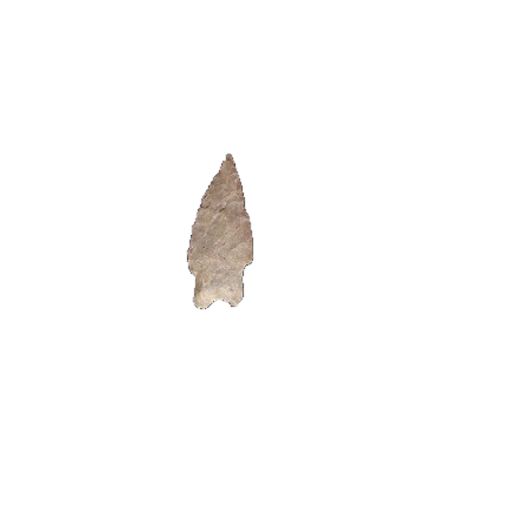
Arrowhead type
Yonkee Point
YonkeeMcKean Cluster3,100 - 2,300 B.P.Transitional Archaic10 reference photos
Key facts
- Age
- 3,100 - 2,300 B.P.
- Cultural period
- Transitional Archaic
- Size
- Medium
- Shape
- Expanding Stem to Corner Notch
- Glacial period
- Neoglacial
More from the Archaic period
Description
This artifact exhibits a distinctive, elongated triangular form with a medium-sized stem, characterized by an elliptical profile. The blade's curvature is pronounced, displaying a notable excurvate shape. The shoulder morphology can range from angled to barbed, presenting a varied profile. The stem expands downward, terminating in a base that features a pronounced notch or thinning, resulting in a conspicuous basal concavity. The flaking pattern on this point appears to be random, lacking a discernible order or sequence.
Size
The dimensions of the arrowheads are characterized by the following measurements: the overall length ranges from 40 to 70 mm, while the stem length spans 8 to 12 mm. The blade width is between 18 and 27 mm, and the neck width falls within the range of 12 to 17 mm. The stem width, typically 10% narrower than the blade width, measures between 17 and 21 mm.
Distribution
This specimen is a characteristic prairie projectile that predominantly occurs in the Northern Grasslands. It is most frequently discovered in Canada, and has also been unearthed in the higher elevation Plains regions.
Mainly found in
Also found, less often, in
Additional information
The McKean complex is a significant archaeological phenomenon characterized by five distinct point types: the McKean point, Duncan Point, Hanna Point, Mallory, and Yonkee point. Notably, the Yonkee point is considered the terminal phase of the McKean complex, as proposed by Bentzen in 1962. It is essential to distinguish the Yonkee point from the Hanna point, as the two are often confused with one another. A notable variation, known as the Southsider Var., represents a transitional phase between the McKean and Duncan points. This type is frequently classified as either a McKean or Duncan point, depending on the extent of lateral edge restriction, highlighting the complexity of point typology within the McKean complex.
The Duncan point, in particular, is also referred to as the Shouldered McKean, underscoring its close affinity with the McKean point. This nomenclature reflects the similarities in morphology between the two point types, with the Duncan point exhibiting a distinctive shoulder formation. The Shouldered McKean designation is also applied to the Southsider Var., further emphasizing the continuum between the McKean and Duncan points. This nuanced understanding of point typology within the McKean complex is crucial for accurately interpreting the cultural and chronological context of archaeological sites associated with these point types.
The McKean complex, with its diverse array of point types, offers valuable insights into the technological and cultural developments of Native American groups during the respective periods of their use. By examining the morphological characteristics and distribution of these points, archaeologists can reconstruct the technological, social, and economic dynamics of these ancient societies. The study of the McKean complex, including the Yonkee, Duncan, and other associated point types, continues to be an essential area of research in North American archaeology, providing a rich understanding of the region's cultural heritage and the evolution of indigenous technologies.
Identified by
- Named by
- Raymond C. Bentzen
- Year
- 1961
- Type site
- Powers-Yonkee Bison Trap site (24PR5), Powder River Valley County, Montana
Similar types
Types that are easy to confuse with the Yonkee point.
- Elko Split Stem
- Fredrick
- Gatecliff Split Stem
- Pinto Basin
- San Jose