
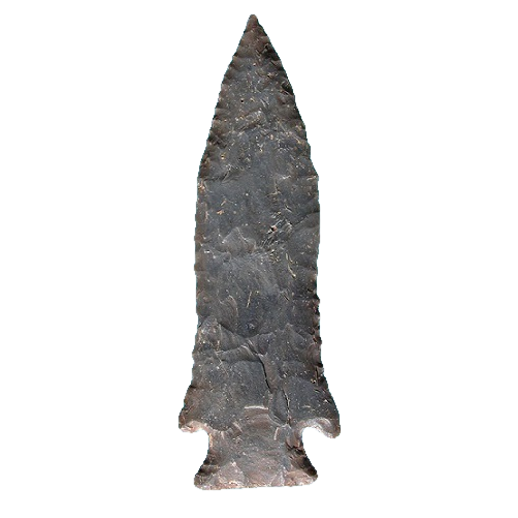
Arrowhead type
Pine-Tree Point
Pine-TreeKirk Corner Notch Cluster9,500 - 8,500 B.P.Early Archaic27 reference photos
Key facts
- Age
- 9,500 - 8,500 B.P.
- Cultural period
- Early Archaic
- Size
- Medium to Large
- Shape
- Corner Notch to Bifurcated
- Material
- Limestone
- Glacial period
- Early Holocene
More from the Archaic period
Description
This medium-sized corner-notched point exhibits a distinctive cross-sectional profile, characterized by an elliptical shape with a flattened or median ridge. The blade's curvature is predominantly outwardly recurved, although some specimens may display a straight or slightly incurvate edge. Serrations are a common feature along the blade's length. The shoulders are typically oriented horizontally, with a slight upward inclination in some cases. The stem expands in width, while the base exhibits variability, ranging from convex to concave contours. The flaking pattern observed on this point is primarily collateral, with occasional random flaking evident.
Size
The dimensions of the arrowheads are as follows: they typically range in overall length from 40 to 72 millimeters, with an average length of 54 millimeters. The stem of the arrowhead measures between 10 and 13 millimeters in length, averaging 11 millimeters. The blade width varies from 23 to 32 millimeters, with a mean width of 27 millimeters. Conversely, the stem width ranges from 25 to 30 millimeters, averaging 28 millimeters. In terms of thickness, the arrowheads are between 7 and 8 millimeters thick.
Distribution
This point occurs within the Tennessee River basin and extends into the Ohio River region, reaching the central Mississippi River area
Additional information
In the realm of Native American arrowheads, the Pine Tree point is a notable variant that has sparked considerable discussion among archaeologists. According to Justice (2002), this point is essentially a re-sharpened version of the Kirk Corner Notch point, characterized by a narrower and potentially thinner blade. Notably, despite the re-sharpening process, the Pine Tree point retains the original blade length of its Kirk Corner Notch counterpart. The work of Cambron and Hulse (1969) provides further insight into the hafting characteristics of this point, which are identical to those of the Kirk Corner Notched point.
The Pine Tree point is often confused with the Charleston point, due in part to their similar appearances and overlapping geographic distributions. However, these two points are distinct and should not be considered the same, as evidenced by their stratigraphic positions at the St. Albans site and Ice House Bottom site, where the Charleston Corner Notched point was found in lower levels than the Kirk Corner Notched point (Justice, 2002). To accurately distinguish between the two, several key factors must be considered. Firstly, their distributions differ, with the Charleston point extending further east and the Pine Tree point reaching further north. Additionally, Broyle (1971) observes that the Charleston blade tends to be shorter and wider, often exhibiting a recurvate and asymmetrical shape, whereas the Pine Tree point retains a base consistent with the Kirk Base, given its status as a re-sharpened Kirk variant.
A closer examination of the morphological characteristics of these points reveals further differences. The Charleston point frequently features a median ridge, a trait less common in the Pine Tree point. Moreover, basal grinding is more prevalent in the Charleston point, similar to the Palmer point, which predates the Kirk. In contrast, the Pine Tree point, as a re-sharpened Kirk variant, exhibits less frequent basal grinding. By recognizing these subtle distinctions, archaeologists can more accurately identify and contextualize these significant artifacts, ultimately enhancing our understanding of the cultural and technological developments of Native American communities.
Identified by
- Named by
- James Cambron
- Year
- 1956
- Type site
- Pine Tree site (Cambron site 76), Limestone County, Alabama
Similar types
Types that are easy to confuse with the Pine-Tree point.
- Bare Island
- Duncan's Island
- Genesee
- Hover Island
- Neville
- Lackawaxen
- Newmanstown
- Piney Island
- Tocks Island
Other types in the Kirk Corner Notch Cluster
- Amos
- Charleston Corner Notch
- Decatur
- Kirk Corner Notch
- Palmer
- Stilwell