
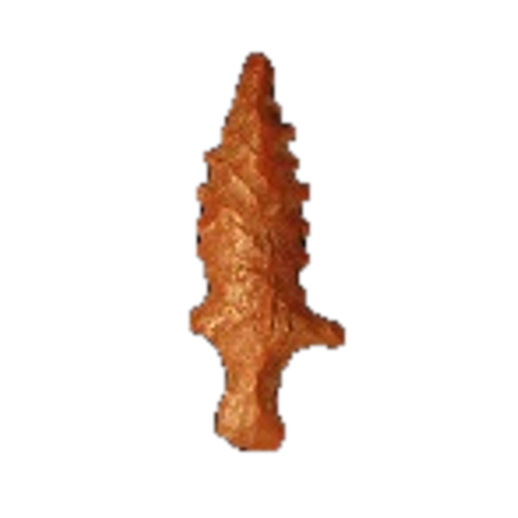
Arrowhead type
Livermore Point
LivermoreLivermore Stemmed Cluster1,200 - 800 B.P.Developmental to Prehistoric8 reference photos
Key facts
- Age
- 1,200 - 800 B.P.
- Cultural period
- Developmental to Prehistoric
- Culture
- Phase:
- Size
- Small
- Shape
- Straight Stem to Expanding Stem to Contracting Stem
- Glacial period
- Vandal Minimum to Medieval Warm
More from the Developmental period
Description
This medium-sized, stemmed projectile point exhibits a distinctive morphology, characterized by a cross-sectional shape that ranges from flattened to elliptical. The blade itself is marked by an incurvate profile, with a notable flare at the shoulder, creating a distinctive silhouette. In some instances, this flaring can be quite pronounced, giving the point a cruciform appearance. The blade edges often feature deep serrations, adding to the point's overall complexity. The shoulders are typically broad and barbed, although they can also slope downward or assume a horizontal orientation. The stem is generally straight, but may exhibit a slight contraction or expansion. The basal edge varies, ranging from straight to convex, with the latter sometimes accompanied by a bulbous swelling of the stem. The flaking pattern on this point is random, lacking a discernible order or sequence.
Size
The dimensions of the arrowheads are characterized by the following measurements: overall length ranges from 21 to 50 mm, with the blade spanning 5 to 10 mm in width. The shoulder exhibits a width of 12 to 30 mm, while the stem width varies between 4 to 10 mm. Additionally, the thickness of the arrowheads falls within a range of 4 to 7 mm.
Distribution
This type is mainly located in the Trans-Pecos area of Texas and Chihuahua. It can also be discovered in the Midland Texas area and across the Guadalupe Mountains. It can be found less often in southeastern Arizona
Mainly found in
Additional information
In the realm of Native American arrowheads, the Livermore type bears a notable resemblance to the Neff point, with both exhibiting distinct characteristics that set them apart from other types. A key differentiating feature between the two lies in the stem morphology, where the Neff type typically displays a more pronounced expanding stem, whereas the Livermore type tends to have a less expansive stem. This subtle distinction can sometimes make it challenging for archaeologists to accurately categorize individual specimens, as the overlapping traits between the two types can lead to difficulties in distinguishing between them.
Upon closer examination, the nuances in stem shape and size become more apparent, allowing for a more informed classification. The Neff type's expanding stem is a hallmark characteristic, often serving as a diagnostic feature in identifying this particular point style. In contrast, the Livermore type's less expansive stem, while similar, exhibits a more subdued morphology. By carefully considering these differences, researchers can work to clarify the boundaries between these two point types, ultimately enhancing our understanding of the technological and cultural developments within the Native American communities that crafted these artifacts.
The similarity between the Livermore and Neff types underscores the complexity and diversity of Native American arrowhead styles, highlighting the need for meticulous analysis and careful consideration of multiple characteristics when attempting to classify individual specimens. By acknowledging the overlapping traits between these point types, archaeologists can refine their understanding of the cultural and historical contexts in which they were created, shedding light on the lives and traditions of the people who crafted these intricate and often beautiful artifacts.
Identified by
- Named by
- Charles Kelly
- Year
- 1940
Similar types
Types that are easy to confuse with the Livermore point.