
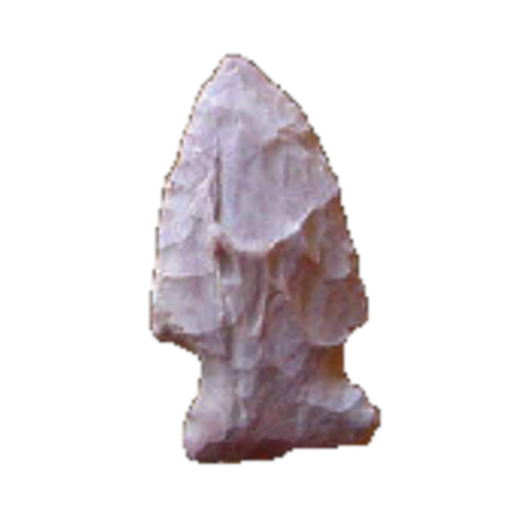
Arrowhead type
Amargosa Point
AmargosaElko Corner Notch Cluster3,000 - 2,000 B.P.Late ArchaicKey facts
- Age
- 3,000 - 2,000 B.P.
- Cultural period
- Late Archaic
- Culture
- Amargosa Culture
- Size
- Small to Medium
- Shape
- Corner Notch
- Glacial period
- Neoglacial to Roman Warm
More from the Archaic period
Description
This triangular corner-notched point exhibits a distinctive morphology, characterized by a cross-sectional shape that ranges from flattened to elliptical. The blade profile can vary from subtly curved to straight, often featuring fine serrations along its edge. The shoulders are marked by barbed extensions that taper to a sharp terminus, with the barb tips being broader than the basal ears. The diagonal notches that define the corner are typically deep and narrow, intersecting the blade at a pronounced angle. The stem expands outward, terminating in a base that is either straight or slightly convex. In terms of flaking patterns, this point typically displays a random arrangement of flakes, although some specimens may exhibit a more organized parallel-oblique pattern.
Size
The dimensions of the arrowheads are as follows: they range in overall length from 29 to 42 mm, with a mean length of 32 mm. The stem measures between 5 and 11 mm in length. The blade width varies from 16 to 23 mm, averaging 18 mm. Additionally, the neck width spans 12 to 20 mm, while the basal width ranges from 13 to 22 mm. In terms of thickness, the arrowheads measure between 5 and 7 mm.
Distribution
This type is located in the southern regions of California, the southern parts of Nevada, the northern areas of Baja California, and the western sections of Arizona, within territories linked to the Amargosa Complex 1-3 zones.
Mainly found in
Additional information
The evolution of Native American arrowheads is a fascinating topic, and the Amargosa type is a significant example of this development. Emerging from the Pinto type, the Amargosa points played a crucial role in the transition from dart to arrow technology, a shift that occurred during the Basketmaker III and Pueblo II periods. This technological advancement, noted by Rogers in 1966, marked a significant milestone in the history of projectile points. The Amargosa type, which may be closely related to the Elko type, exhibits characteristics that are still debated among archaeologists, with some arguing that it may not represent a distinct type, but rather a variant of the Elko series.
Despite these debates, the Amargosa type is widely recognized in professional circles, often referred to as part of the Elko Series. One of the notable features of the Amargosa type is its variability, with both stemmed and corner notch variants present. This diversity suggests that the Amargosa points were adapted to different functional needs, highlighting the ingenuity and resourcefulness of the cultures that created them. The Amargosa Complex, which spanned from periods 1 to 3, is particularly associated with these points, demonstrating the significance of this type in the archaeological record.
The study of the Amargosa type offers valuable insights into the lives and technologies of Native American communities during the Basketmaker III and Pueblo II periods. By examining the characteristics and variations of these points, archaeologists can reconstruct the cultural and historical contexts in which they were created and used. The Amargosa type, with its connections to the Elko series and its role in the transition to arrow technology, is an important part of this narrative, shedding light on the complex and dynamic history of Native American cultures in the region.
Identified by
- Named by
- Malcolm Rogers
- Year
- 1939
Similar types
Types that are easy to confuse with the Amargosa point.