
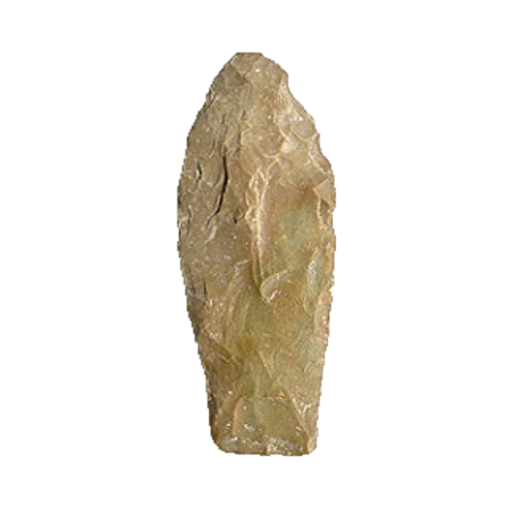
Arrowhead type
Hell Gap Point
Hell GapPlano Lanceolate Cluster10,0500 - 9,550 B.P.Transitional Paleo20 reference photos
Key facts
- Age
- 10,0500 - 9,550 B.P.
- Cultural period
- Transitional Paleo
- Size
- Medium to Large
- Shape
- Lanceolate to Straight Stem
- Material
- Agate
- Glacial period
- Late Pleistocene to Early Holocene
More from the Paleo period
Description
This lanceolate point exhibits a medium to large size, characterized by an elliptical cross-sectional profile. The blade's curvature is predominantly excurvate, although specimens with subdued shoulders can create a recurvate illusion. The blade's maximum width is situated just above the shoulder area, typically spanning between one-half to one-fourth of the point's overall length, with this proportion potentially varying in reworked examples. The shoulders themselves are often faint or absent, with an upward inclination. The stem is notably long, displaying a range of forms from slightly tapering to straight. The base of the point is generally straight, but can exhibit subtle variations, ranging from slightly concave to slightly convex. The lateral edges intended for hafting often show intense grinding, whereas the basal edge may display minimal to no grinding. The point's thinning is achieved through a combination of percussion flaking and subsequent pressure flaking, resulting in a finish that ranges from random to parallel or horizontal transverse patterns.
Size
The dimensions of these arrowheads are characterized by a total length ranging from 40 to 130 millimeters, with a typical average span of 60 to 70 millimeters. The maximum width of the blade falls within the range of 20 to 40 millimeters, while the basal width measures between 15 and 25 millimeters.
Distribution
This type is linked to the grasslands of the US and the open spaces of Canadian territory. It has been spotted in the western mountain ranges and the high deserts of Colorado, and across the flatlands of Minnesota to the east. It appears less often in the southern coastal areas of Texas and into Mexican lands
Mainly found in
Also found, less often, in
Additional information
In the realm of Native American arrowhead identification, the Hell Gap point is often subject to misclassification, with some specimens being mistaken for Agate Basin or Angostura points, and vice versa (Turner and Hester, 1985). This confusion is particularly pronounced when dealing with heavily re-sharpened Agate Basin and Angostura points, which can bear a striking resemblance to Hell Gap points (Boszhardt, 2003). However, a closer examination of the technological characteristics reveals that Hell Gap projectile points may have evolved from the Agate Basin tradition, as suggested by Frison (1991). This continuity in technological development highlights the complex and dynamic nature of prehistoric tool production.
The geographic distribution of Hell Gap points is also noteworthy, with potential eastern extensions of this type being represented by the Madina point found in Ontario. This discovery underscores the possibility of cultural exchange and technological diffusion across vast distances. In contrast, regional variations of the Hell Gap point have been identified, such as the smaller variant found in Iowa, which Morrow (1984) refers to as the Cherokee point. This variation underscores the importance of considering regional and temporal contexts when analyzing projectile point typologies.
A comprehensive understanding of the Hell Gap point requires consideration of its technological, geographic, and cultural contexts. By examining the similarities and differences between Hell Gap and other point types, such as Agate Basin and Angostura, researchers can gain valuable insights into the lives and traditions of the Native American groups that created these artifacts. The study of projectile point typologies, including the Hell Gap point, continues to be an essential aspect of archaeological research, offering a unique window into the technological, social, and cultural developments of prehistoric societies.
Identified by
- Named by
- George A. Agogino
- Year
- 1961
- Type site
- Hell Gap Site, Hell Gap Valley, Platte County, Wyoming
Similar types
Types that are easy to confuse with the Hell Gap point.
- Agate Basin
- Angostura
- Bajada
- Browns Valley
- Burroughs
- Escobas
- Haskett Type I
- Jay
- Lake Mojave
- Pelican
- Pryor
- Rio Grande