
Arrowhead type
Zella Point
Zella8,800 - 8,100 B.P.Late Paleo to Early Archaic3 reference photos
Key facts
- Age
- 8,800 - 8,100 B.P.
- Cultural period
- Late Paleo to Early Archaic
- Size
- Medium to Large
- Shape
- Ovoid to Lanceolate
- Material
- Agate
- Glacial period
- Early Holocene
Description
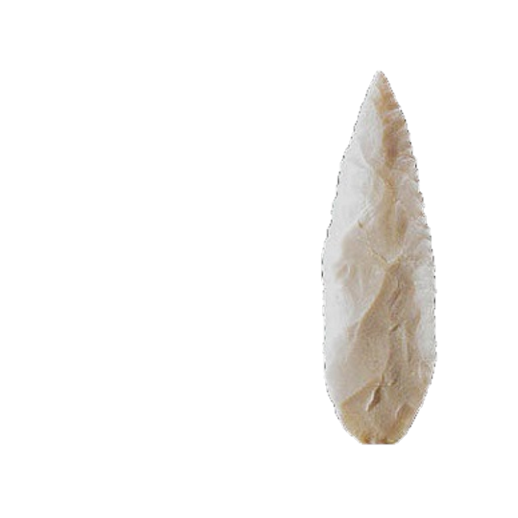
This lanceolate point exhibits a medium to large size, characterized by an ovoid silhouette and an elliptical profile. The blade's curvature is distinctive, with an excurvate shape that tapers inward at the apex and outward at the base. The basal edge varies in shape, ranging from a straight line to a subtly convex or concave contour, often accompanied by evidence of basal thinning or grinding. The flaking pattern typically displays oblique parallel ridges, although random flaking is also a prevalent feature. Less frequently observed is a horizontal transverse flaking pattern, which adds to the point's morphological diversity.
Size
The dimensions of the arrowheads are as follows: they range in length from 50 to 105 mm, with blade widths spanning 18 to 42 mm, and exhibit an average thickness of 9 mm.
Distribution
This type is mainly discovered in eastern and southern central Texas, extending into the Coastal Plains area.
Mainly found in
Additional information
In a seminal study published in 1983, Thomas Kelly conducted a comprehensive analysis of Angostura points discovered in the central Coastal Plains region of Texas, with a particular focus on those found in McMullen County. This research yielded significant insights into the variability of Angostura points within the state. Kelly's meticulous examination led to the identification of three distinct variants, which he subsequently classified and named. These variants, now recognized as distinct types, are referred to as the Texas Angostura, Victoria Angostura, and Zella Angostura. This taxonomy has since provided a framework for understanding the diversity of Angostura points in Texas, highlighting the importance of regional characteristics in the classification of these archaeological artifacts.
The identification of these three variants by Kelly underscores the complexity and nuance of Angostura point morphology in Texas. Each type, whether Texas Angostura, Victoria Angostura, or Zella Angostura, exhibits unique characteristics that set it apart from the others, reflecting the cultural and technological adaptations of the Native American groups that crafted them. The presence of these distinct types in central Texas, particularly in McMullen County, speaks to the rich cultural heritage and the dynamic interactions between different Native American communities in the region.
Kelly's work not only contributes to our understanding of the technological and stylistic evolution of arrowheads in the Coastal Plains region of Texas but also highlights the significance of detailed typological analyses in archaeology. By recognizing and categorizing these variants, researchers can better comprehend the spatial and temporal distributions of different cultural groups, as well as their technological and artistic traditions. The Texas Angostura, Victoria Angostura, and Zella Angostura types, as defined by Kelly, serve as important markers for tracing the history and movements of Native American populations in Texas, offering valuable insights into the lives and traditions of these communities.
Identified by
- Named by
- Thomas C. Kelley
- Year
- 1983
Similar types
Types that are easy to confuse with the Zella point.
- Agate Basin
- Angostura
- Lerma
- Mahaffey