
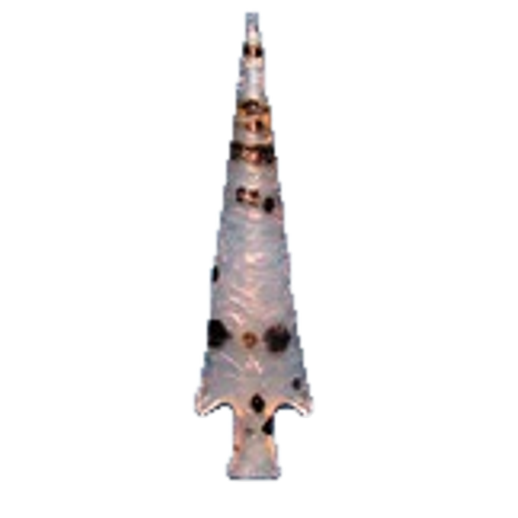
Arrowhead type
Abajo Point
AbajoDolores Cluster1,400 - 1,000 B.P.Late ArchaicKey facts
- Age
- 1,400 - 1,000 B.P.
- Cultural period
- Late Archaic
- Culture
- Anasazi Culture
- Size
- Small
- Shape
- Expanding Stem
- Material
- Utilized
- Glacial period
- Vandal Minimum to Medieval
More from the Archaic period
Description
This diminutive point, measuring between 1.25 and 1.75 inches in length, exhibits a triangular form with a stemmed to expanding stem configuration. Its cross-sectional profile is characterized by a flattened shape, while the blade itself remains largely straight, terminating in a sharp, well-defined tip. The stem is notable for its elongated proportions and subtle expansion. The basal edge varies in curvature, ranging from a straight alignment to a gently convex shape. The flaking pattern observed on this point is random, lacking a discernible, organized arrangement.
Size
Small
Distribution
This type is mainly discovered in regions linked to Ancestral Puebloan locations. This type may be discovered on the Colorado Plateau in the southern Manti La Sal range and southward to the Su Site of New Mexico and westward to Navajo Mountain
Mainly found in
Additional information
The arrowhead in question belongs to a distinct variant of the Dolores type, characterized by a notable elongation of its stem. This distinguishing feature sets it apart from the Dolores Expanding Stem, with which it shares other similarities. Notably, research has linked this particular type to the High Altitude Anasazi Lithic Assemblage, a connection first proposed by Dykman in 1976. This association underscores the significance of this arrowhead variant within the context of Anasazi material culture, highlighting the importance of lithic analysis in understanding the technological and cultural practices of this ancient group.
The High Altitude Anasazi Lithic Assemblage is a significant archaeological concept, as it sheds light on the adaptive strategies and technological innovations of Anasazi communities inhabiting high-altitude regions. The inclusion of this Dolores variant within this assemblage suggests a degree of cultural and technological continuity among these communities, despite the challenges posed by their elevated environments. Further study of this arrowhead type and its associations can provide valuable insights into the lives and traditions of the Anasazi people, as well as the broader cultural and historical context of the region.
The identification of this arrowhead as part of the High Altitude Anasazi Lithic Assemblage also underscores the importance of meticulous typological analysis in archaeology. By recognizing and categorizing distinct variants like this Dolores type, researchers can reconstruct the complex cultural and technological landscapes of the past, ultimately deepening our understanding of human history and cultural diversity. As such, this arrowhead variant serves as a significant artifact, offering a window into the lives and traditions of the Anasazi people and their remarkable adaptability in the face of environmental challenges.
Identified by
- Named by
- James L. Dykman
- Year
- 1976
- Type site
- Abajo Site (29SJ116), San Juan County, New Mexico
Similar types
Types that are easy to confuse with the Abajo point.