
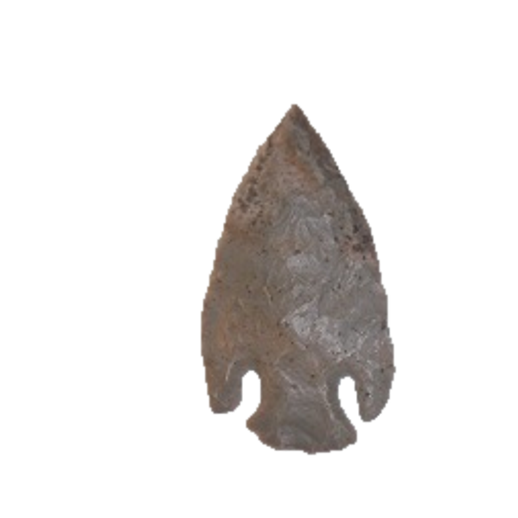
Arrowhead type
Carlsbad Point
Carlsbad3,000 - 1,600 B.P.Transitional Archaic to Early Woodland2 reference photos
Key facts
- Age
- 3,000 - 1,600 B.P.
- Cultural period
- Transitional Archaic to Early Woodland
- Size
- Small to Medium
- Shape
- Corner Notch
- Glacial period
- Neoglacial to Roman Warm
Description
This triangular corner notch point exhibits a compact to moderate size, characterized by an elliptical cross-sectional profile. The blade morphology ranges from gently curved to straight, with notches typically initiating at the corners of the preform and extending deeply into the blade, resulting in a constricted neck. The shoulders are often barbed, although re-sharpening can lead to a reduction or complete loss of this feature. The shoulder orientation can vary, spanning from a pronounced barb to a subtle upward inclination. The stem expands downward, terminating in a convex base. The flaking pattern on this point is irregular and non-directional, lacking a discernible pattern.
Size
The arrowhead's dimensions are characterized by a total length ranging from 33 to 65 mm. The stem, which forms the base of the arrowhead, measures between 10 to 14 mm in length and 10 to 17 mm in width. The blade, the primary cutting edge, exhibits a width of 17 to 32 mm, while the neck, the transitional zone between the blade and stem, has a width of 7 to 13 mm.
Distribution
This type is mainly discovered in the Carlsbad area of New Mexico, encompassing the Guadalupe and Sacramento mountain ranges within that area. It has also been located in the El Paso area, albeit with less regularity.
Mainly found in
Additional information
In the realm of Native American arrowheads, a distinct point type bears a notable resemblance to the Tularosa Corner Notch point, yet exhibits certain distinguishing characteristics. One of the primary differences lies in the base shape, which tends to be more convex in nature. Additionally, the neck of this point is typically narrower compared to its Tularosa counterpart. These subtle variations in morphology set this point type apart, highlighting the diversity and complexity of arrowhead design among Native American cultures.
The convex base and narrower neck of this point type are significant features that contribute to its unique identity. The more curved base may have provided a stronger hafting platform, allowing for a more secure attachment to the arrow shaft. In contrast, the narrower neck may have influenced the point's aerodynamics, potentially affecting its flight trajectory and overall performance. These design elements demonstrate the ingenuity and adaptability of Native American craftsmen, who carefully considered the functional requirements of their hunting tools.
The similarities between this point type and the Tularosa Corner Notch point underscore the shared technological and cultural heritage of the regions in which they were produced. Despite their differences, both point types reflect a deep understanding of the materials and manufacturing techniques employed by Native American arrowhead makers. By examining these subtle variations, archaeologists can gain a more nuanced understanding of the cultural exchange networks, technological innovations, and environmental adaptations that shaped the lives of Native American communities.
Identified by
- Named by
- Robert Leslie
- Year
- 1978
Similar types
Types that are easy to confuse with the Carlsbad point.