
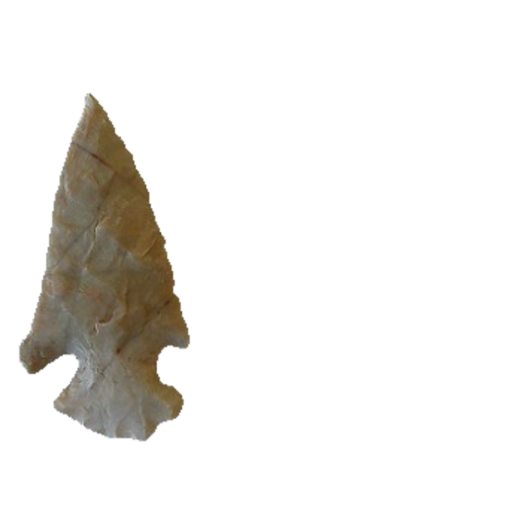
Arrowhead type
Cienega Point
Cienega2,100 - 1,300 B.P.Transitional Archaic to Developmental8 reference photos
Key facts
- Age
- 2,100 - 1,300 B.P.
- Cultural period
- Transitional Archaic to Developmental
- Culture
- Mogollon Culture
- Size
- Small to Medium
- Shape
- Corner Notch to Basal Notch
- Glacial period
- Roman
More from the Archaic, Developmental periods
Description
This triangular point exhibits a compact to moderate size, characterized by an elliptical profile. The blade's curvature can range from gently excurvate to straight, with notches that extend from the preform's corners to its base, creating shoulders that vary in barbing intensity, from subtle to pronounced. In some instances, the notch's entry point is slightly above the corner, resulting in a nearly horizontal shoulder. The stem, which expands in width, can be either straight or convexly shaped. Notably, this point lacks evidence of hafting grinding. The flaking pattern observed on this point is random, indicating a non-patterned approach to stone tool production.
Size
The arrowheads exhibit a range of dimensions, with overall lengths spanning from 22 to 75 mm. The stem section measures between 9 and 13 mm in length. In terms of width, the blade ranges from 19 to 36 mm, while the neck width varies from 9 to 16 mm. Additionally, the stem width is recorded to be between 13 and 21 mm.
Distribution
This type is mainly discovered at Mogollon localities and exchange areas of southeastern Arizona and northwestern New Mexico. This type has been identified as far as southwestern Colorado. The range stretches into northern Chihuahua and northeastern Sonora Mexico
Additional information
The classification of these distinctive arrowhead points was first introduced by Huckell and Haury in their 1988 research. Subsequent studies by Justice in 2002 led to a further refinement of this category, resulting in the identification of three distinct sub-types: the Tularosa Corner Notch, the Tularosa Basal Notch, and the Guadalupe point. Notably, Justice's 2002 findings also suggest that this point type likely originated from the San Pedro type, highlighting an important evolutionary connection between these two archaeological forms. This insight provides valuable context for understanding the development and diversification of arrowhead designs in the region, underscoring the significance of meticulous typological analysis in reconstructing the technological and cultural trajectories of ancient societies.
Identified by
- Named by
- Bruce B. Huckell and Emil W. Haury
- Year
- 1988
- Type site
- Two Late Archaic sites in Cienega Valley
Similar types
Types that are easy to confuse with the Cienega point.
Other types in this cluster
- Guadalupe