
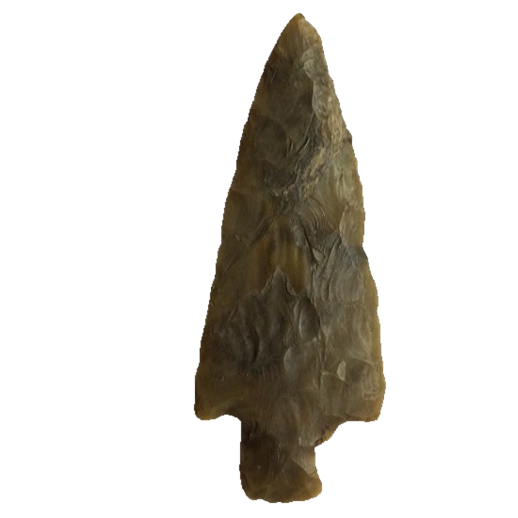
Arrowhead type
Robins Point
RobinsAdena Cluster2,500 - 1,500 B.P.Woodland22 reference photos
Key facts
- Age
- 2,500 - 1,500 B.P.
- Cultural period
- Woodland
- Culture
- Adena culture
- Size
- Medium to Large
- Shape
- Straight Stem to Contracting Stem to Expanding Stem
- Glacial period
- Neoglacial to Roman Warm
More from the Woodland period
Description
This triangular stemmed point exhibits a distinctive morphology, characterized by a broad, medium to large-sized blade with a cross-sectional profile that ranges from flattened to elliptical. The blade's curvature is predominantly excurvate, with its maximum width typically occurring just above the pronounced shoulders, which may be slightly barbed or, less commonly, horizontal. The stem is relatively narrow and square in shape, featuring rounded corners at its base, and often extends longer than its width. The basal edge is generally straight, although it may be convex, and lacks evidence of grinding in the hafting region. The point's manufacture involves an initial stage of random percussion flaking, supplemented by pressure flaking to refine and retouch the blade, resulting in a random, multi-directional flaking pattern.
Size
The dimensions of these arrowheads are characterized by the following measurements: - Length ranges from 50 mm to 150 mm, with a typical average length of 70 mm to 80 mm. - The stem length varies between 15 mm and 30 mm, averaging approximately 21 mm. - Blade width spans from 23 mm to 55 mm, with an average width falling within the 35 mm to 40 mm range. - The width of the stem is between 18 mm and 27 mm, averaging around 24 mm. - In terms of thickness, the arrowheads measure between 7 mm and 15 mm, with an average thickness of 9 mm.
Distribution
These artifacts are located within the Ohio River Valley region. The typical dispersion of the Adena points is highlighted in red (see Additional Comments). The yellow area represents the sphere of influence and exchange network of the Mound Builders, encompassing the Adena, Hopewell, and Mississippian Cultures.
Mainly found in
Also found, less often, in
Additional information
The Adena point, a distinctive arrowhead style, is predominantly associated with the Adena Culture, which flourished in the Ohio River Valley. This region served as the epicenter of Adena cultural activities, and it is likely that the Adena point originated here. Notably, similar point styles are found within the broader Mound Builder Distribution, including the Waubesa point, linked to the Hopewell culture, and the Dickson, Mason, and Florence points, which are characteristic of the Red Ocher Culture. These similarities highlight the complex cultural exchange networks that existed among prehistoric societies in Eastern North America.
The Adena point's chronology spans the late Archaic period to the early and middle Woodland period, as documented by Justice in 1987. Interestingly, early Adena points appear to have emerged in the Tennessee River Valley, from which they disseminated to other areas during the early Woodland period, as observed by Kneberg in 1956. The evolution of the Adena point is thought to have been influenced by the Cresap point, with variations of the Adena point developing over time. This process of stylistic development and diffusion underscores the dynamic nature of prehistoric cultural expression.
When encountering Adena-style points outside the Adena Cultural area, it is essential to consider the possibility that they may represent similar, yet distinct, point styles. A thorough evaluation of these points can provide valuable insights into the cultural exchange networks and technological traditions of prehistoric societies. By examining the distribution, chronology, and stylistic variations of the Adena point, researchers can gain a deeper understanding of the complex cultural landscape of Eastern North America during the late Archaic and Woodland periods. This, in turn, can inform our appreciation of the region's rich cultural heritage and the ingenuity of its prehistoric inhabitants.
Identified by
- Named by
- Don W. Dragoo
- Year
- 1963
- Type site
- Robbins Mound, Boone County, Kentucky
Similar types
Types that are easy to confuse with the Robins point.
- Burkett
- Elk River
- Genesee
- Kent
- Kramer
- Hamilton Stemmed
- Hidden Valley
- Macon
- New Market
- Piedmont
- Pontchartrain
Other types in the Adena Cluster
- Adena
- Adena Blade
- Dickson
- Adena Narrow Stem
- Adena Snapped Base
- Adena Vanishing Stem
- Waubesa
- Cresap
- Fulton Turkeytail
- Gary
- Harrison Turkeytail
- Hebron Turkeytail
- Little Bear Creek