
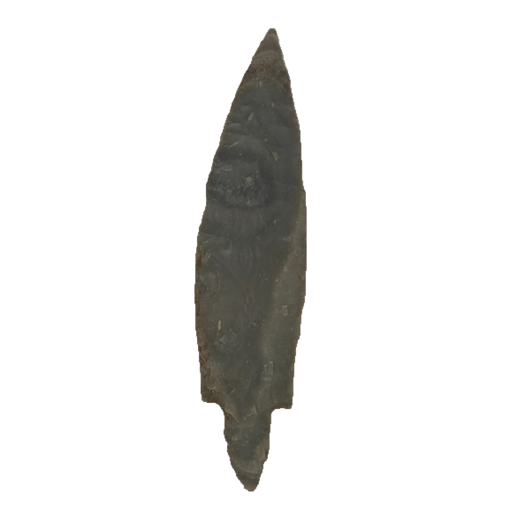
Arrowhead type
Hebron Turkeytail Point
Hebron TurkeytailTurkeytail Cluster4,000 - 2,500 B.P.Late Archaic to Early Woodland15 reference photos
Key facts
- Age
- 4,000 - 2,500 B.P.
- Cultural period
- Late Archaic to Early Woodland
- Culture
- Adena Culture
- Size
- Medium to Large
- Shape
- Contracting Stem
- Glacial period
- Neoglacial
Description
This triangular point exhibits a medium to large size, characterized by a stem that tapers towards the base, and a cross-sectional shape that ranges from flattened to elliptical. The blade's profile is predominantly excurvate, although some specimens may display a straight configuration. The shoulders slope downward, forming a straight edge, while the stem contracts towards the base, which can be either pointed or strongly convex. The flaking pattern observed on this point is random, lacking a discernible order or orientation.
Size
The arrowheads exhibit a range of dimensions, with overall lengths spanning 50 to 170 mm. The stem, which forms the base of the arrowhead, measures between 16 and 29 mm in length. In terms of width, the blade itself ranges from 23 to 39 mm, while the stem width at the shoulder joint varies between 13 and 30 mm.
Distribution
This point exhibits the greatest density in the Ohio River Valley. Additionally, it can be located in the Great Lakes area and throughout the Tennessee River valley
Mainly found in
Additional information
In the realm of Native American arrowheads, a distinctive variation stands out due to its unique stem morphology. Characterized by a more pronounced contraction, this stem shape differentiates it from other known variations. Notably, this particular type is relatively rare, making it a significant find for archaeologists and collectors alike.
A comparative analysis reveals a striking similarity between this variation and the Adena Waubesa point, a type of arrowhead associated with the Adena culture. However, a closer examination reveals a key distinguishing feature: the shoulder of this variation exhibits a straight, downward-angled profile. This subtle yet significant difference underscores the complexity and diversity of Native American arrowhead designs, highlighting the importance of meticulous classification and analysis in the field of archaeology.
The study of this uncommon variation offers valuable insights into the technological and cultural developments of Native American societies. By examining the morphological characteristics of arrowheads like this one, researchers can gain a deeper understanding of the historical context, cultural exchange, and technological innovations that shaped the lives of indigenous peoples. As such, this variation serves as a fascinating example of the rich cultural heritage and artisanal expertise of Native American communities, inviting further investigation and appreciation of these remarkable artifacts.
Identified by
- Named by
- Lewis R. Binford
- Year
- 1963
Similar types
Types that are easy to confuse with the Hebron Turkeytail point.
- Turkeytail Fulton
- Turkeytail Harrison
- Turkeytail Tupelo
Other types in the Turkeytail Cluster
- Adena Blade
- Adena Dickson
- Adena Narrow Stem
- Adena Robbins
- Adena Snapped Base
- Adena Vanishing Stem
- Adena Waubesa
- Cresap
- Gary
- Harrison
- Kramer
- Little Bear Creek