
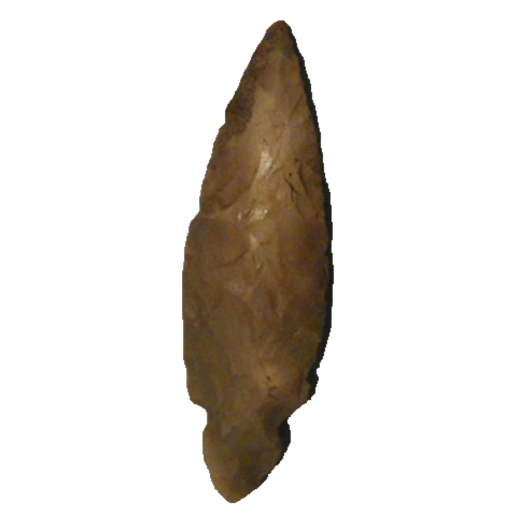
Arrowhead type
Fulton Turkeytail Point
Fulton TurkeytailTurkeytail Cluster4,000 - 2,500 B.P.Late Archaic to Early Woodland19 reference photos
Key facts
- Age
- 4,000 - 2,500 B.P.
- Cultural period
- Late Archaic to Early Woodland
- Culture
- Adena Culture
- Size
- Medium to Large
- Shape
- Side Notch
- Glacial period
- Neoglacial
Description
This side-notched point exhibits a slender profile with a medium to large size, characterized by a cross-section that has been deliberately flattened. The blade itself displays an excurvate shape, reminiscent of a leaf, with its curved outline. Notably, the notches are positioned in a parallel arrangement, situated relatively low on the blade, nearing the base. The shoulders of the point are predominantly horizontal in orientation. The stem, which may exhibit a slight expansion at the notch, subsequently tapers to a pointed termination. The flaking pattern observed on this point is random in nature, yet the overall craftsmanship is of high quality, underscoring the skill of its manufacturer.
Size
The dimensions of the arrowheads are as follows: they range in length from 100 to 180 mm, with stem lengths varying between 15 to 40 mm, commonly falling within the 17 to 27 mm range. The blade width spans from 23 to 60 mm, averaging between 25 to 35 mm. The neck width measures between 10 to 35 mm, typically between 12 to 18 mm, while the stem width ranges from 12 to 40 mm, usually between 14 to 20 mm. The thickness of the arrowheads is consistently between 6 to 8 mm.
Distribution
This type is most prevalent in the Ohio River Valley. It can also be located in the Great Lakes area and throughout the Tennessee River valley region
Mainly found in
Also found, less often, in
Additional information
The archaeological record reveals that the points within this cluster were predominantly utilized during the late Archaic period, persisting through the early to middle Woodland period, as noted by Justice in 1987. Notably, the Early Adena points exhibit a strong association with the Tennessee River Valley, from which they appear to have disseminated during the early Woodland period, as observed by Kneberg in 1956. However, it is essential to recognize that the Adena culture is primarily centered in the Ohio River valley, where it is believed to have originated.
A comparable point type, the Tupelo Turkeytail, is found in the lower Tennessee River valley, yet it is not affiliated with the Adena culture and is considered an older point style. In comparison to the Adena points, the Tupelo Turkeytail tends to be thinner, features shallower side notches, and often exhibits a higher level of craftsmanship. Furthermore, a distinct variation of this point type, known as the Fulton/Dickson variation, has been identified, which combines the shape characteristics of the Adena Dickson point with a convex base, rather than the straight base typically associated with the Adena Dickson point, as described by Justice in 1987.
The presence of these point types and their variations provides valuable insights into the cultural and technological developments of the regions in which they were found. The distribution and characteristics of these points highlight the complex interactions and exchanges that occurred between different cultural groups during the late Archaic and early Woodland periods. By examining the similarities and differences between these point types, researchers can gain a deeper understanding of the historical context and the evolution of technological and cultural practices among Native American communities in these regions.
Identified by
- Named by
- Lewis R. Binford
- Year
- 1963
Similar types
Types that are easy to confuse with the Fulton Turkeytail point.
- Turkeytail Harrison
- Turkeytail Hebron
- Turkeytail Tupelo
Other types in the Turkeytail Cluster
- Adena Blade
- Adena Dickson
- Adena Narrow Stem
- Adena Robbins
- Adena Snapped Base
- Adena Vanishing Stem
- Adena Waubesa
- Cresap
- Gary
- Harrison
- Kramer
- Little Bear Creek