
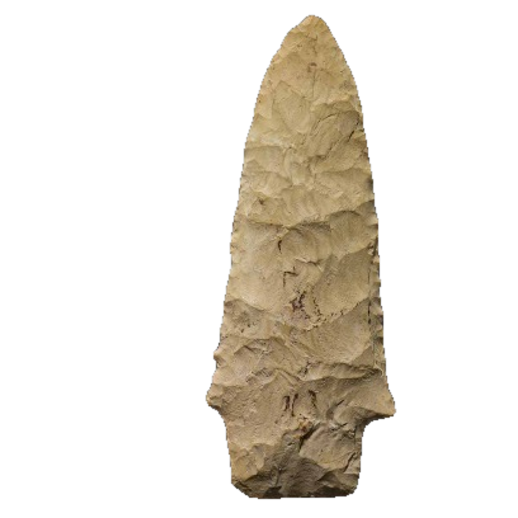
Arrowhead type
Cresap Point
CresapEarly Woodland Stemmed Cluster3,500 - 2,500 B.P.Late Archaic to Woodland10 reference photos
Key facts
- Age
- 3,500 - 2,500 B.P.
- Cultural period
- Late Archaic to Woodland
- Culture
- Adena Culture
- Size
- Medium to Large
- Shape
- Straight Stem to Contracting Stem
- Material
- Felsite
- Glacial period
- Neoglacial
Description
This triangular stemmed point exhibits a medium to large size profile, characterized by an elliptical cross-sectional shape. The blade displays an excurvate morphology, with shoulder edges that can range from straight to rounded in contour. The orientation of the shoulders can vary, spanning from a horizontal alignment to a notable upward inclination. The stem, typically straight in orientation, may occasionally exhibit a subtle expansion or contraction. A straight base serves as the foundation for this point. The flaking pattern observed on this specimen is random, lacking a discernible or consistent arrangement.
Size
The arrowheads exhibit the following dimensional characteristics: their overall length ranges from 50 to 120 mm, with a typical average length of 56 to 70 mm. The stem of the arrowhead measures between 13 and 25 mm in length. In terms of width, the blade spans 20 to 40 mm, averaging 25 mm, while the stem width varies from 13 to 28 mm. The thickness of the arrowhead falls within the range of 7 to 15 mm.
Distribution
These artifacts are located within the Ohio River Valley region. The typical dispersion of the Adena points is highlighted in red (see Additional Comments). The yellow area represents the sphere of influence and exchange network of the Mound Builders, encompassing the Adena, Hopewell, and Mississippian Cultures.
Mainly found in
Also found, less often, in
Additional information
The Adena point, a distinctive projectile point style, is predominantly associated with the Adena Culture, which flourished in the Ohio River Valley. Notably, similar point styles are found within the broader Mound Builder Distribution, including the Waubesa point linked to the Hopewell culture, and the Dickson, Mason, and Florence points associated with the Red Ocher Culture. When encountering Adena-style points outside their traditional cultural area, it is essential to consider the possibility that they may represent analogous types. The chronological span of these points encompasses the late Archaic period to the early and middle Woodland period, as documented by Justice in 1987.
Geographical analysis reveals that early Adena points are frequently found in the Tennessee River Valley, suggesting that this region may have been a key locus for their dissemination during the early Woodland period, as observed by Kneberg in 1956. However, the Adena culture itself is believed to have originated and been centered in the Ohio River Valley. The evolutionary trajectory of the Adena point is thought to have commenced with the Cresap point, from which subsequent variations emerged over time, ultimately giving rise to the earliest recognized Adena Stemmed type, as noted by Justice in 1987. This developmental sequence underscores the complex and dynamic nature of projectile point styles within the Adena Culture and its associated traditions.
The Adena point's characteristics and distribution offer valuable insights into the cultural and technological exchanges that occurred among prehistoric societies in Eastern North America. By examining the stylistic and chronological relationships between Adena points and other contemporaneous styles, researchers can reconstruct the social and economic networks that connected these ancient communities. Furthermore, the study of Adena points highlights the importance of considering both the cultural context and the geographical setting in which these artifacts were produced and used, ultimately enriching our understanding of the region's rich and complex archaeological heritage.
Identified by
- Named by
- Don Dragoo
- Year
- 1963
- Type site
- The Cresap Indian Mound, West Virginia
Similar types
Types that are easy to confuse with the Cresap point.
- Boggy Branch Type 2
- Burkett
- Cypress Stemmed
- Duncan's Island
- Elk River
- Kent
- Kramer
- Hamilton Stemmed
- Hidden Valley
- Macon
- Pontchartrain
Other types in the Early Woodland Stemmed Cluster
- Adena Blade
- Adena Dickson
- Adena Narrow Stem
- Adena Snapped Base
- Adena Vanishing Stem
- Adena Waubesa
- Fulton Turkeytail
- Gary
- Harrison Turkeytail
- Hebron Turkeytail
- Little Bear Creek