
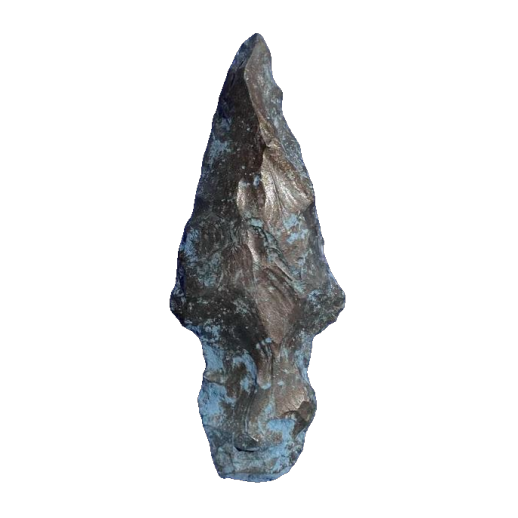
Arrowhead type
Harrison Turkeytail Point
Harrison TurkeytailTurkeytail Cluster4,000 - 2,500 B.P.Late Archaic to Early Woodland15 reference photos
Key facts
- Age
- 4,000 - 2,500 B.P.
- Cultural period
- Late Archaic to Early Woodland
- Culture
- Adena Culture
- Size
- Medium to Large
- Shape
- Side Notch to Contracting Stem
- Glacial period
- Neoglacial
Description
This triangular point exhibits a medium to large size range, characterized by a contracting stem and an elliptical cross-sectional profile. The blade morphology varies, displaying a range from excurvate to straight configurations, particularly in the smaller specimens. The shoulders are predominantly horizontal, although some instances may feature a subtle upward taper. The stem, relatively small in proportion, typically exhibits a slight expansion, but can also maintain a parallel orientation. A distinctive transition occurs where the stem meets the base, which is elongated and tapers to a pointed terminus. The flaking pattern observed on this point is random, lacking a discernible order or arrangement.
Size
The arrowheads exhibit a range of dimensions, with total lengths spanning from 50 to 203 mm. The stem, a crucial component, measures between 15 and 30 mm in length, with an average of 20 mm. In terms of width, the arrowheads vary from 22 to 41 mm. More specifically, the neck width ranges from 11 to 22 mm, while the stem width falls between 13 and 25 mm.
Distribution
This point exhibits the greatest abundance in the Ohio River Valley. Additionally, it can be located in the Great Lakes area and throughout the Tennessee River valley
Mainly found in
Additional information
The arrowhead points in question exhibit a temporal distribution that spans the late Archaic period to the early and middle Woodland period, as noted by Justice in 1987. Notably, the Early Adena points appear to have originated in the Tennessee River Valley, with evidence suggesting that they disseminated from this region during the early Woodland period, as observed by Kneberg in 1956. However, it is essential to recognize that the Adena culture is primarily centered in the Ohio River valley, which is also believed to be the point of origin for this cultural phenomenon.
From a typological perspective, the point in question can be characterized as a hybrid of the Marshall and Mitchell variations of the Turkey Tail point, as identified by Justice in 1987. This classification highlights the complex and nuanced nature of arrowhead point typology, with various regional and cultural influences contributing to the development of distinct point styles. Furthermore, some examples of this point type may exhibit double notches, adding an additional layer of complexity to their morphological characteristics.
The study of these arrowhead points offers valuable insights into the cultural and technological developments of Native American societies during the late Archaic and early Woodland periods. By examining the distribution, typology, and morphological characteristics of these points, researchers can reconstruct the dynamics of cultural exchange, migration, and technological innovation that shaped the lives of indigenous peoples in Eastern North America. As such, the analysis of these points contributes to a deeper understanding of the rich and diverse cultural heritage of Native American communities, highlighting the importance of continued archaeological research and discovery.
Identified by
- Named by
- Lewis R. Binford
- Year
- 1963
Similar types
Types that are easy to confuse with the Harrison Turkeytail point.
- Turkeytail Harrison
- Turkeytail Hebron
- Turkeytail Tupelo
Other types in the Turkeytail Cluster
- Adena Blade
- Adena Dickson
- Adena Narrow Stem
- Adena Robbins
- Adena Snapped Base
- Adena Vanishing Stem
- Adena Waubesa
- Cresap
- Gary
- Harrison
- Kramer
- Little Bear Creek