
Arrowhead type
Genesee Point
GeneseeGenesee Cluster4,900 - 3,800 B.P.Middle Archaic16 reference photos
Key facts
- Age
- 4,900 - 3,800 B.P.
- Cultural period
- Middle Archaic
- Size
- Large
- Shape
- Straight Stem to Contracting Stem to Expanding Stem
- Material
- Argillite
- Glacial period
- Middle Holocene to Neoglacial
More from the Archaic period
Description
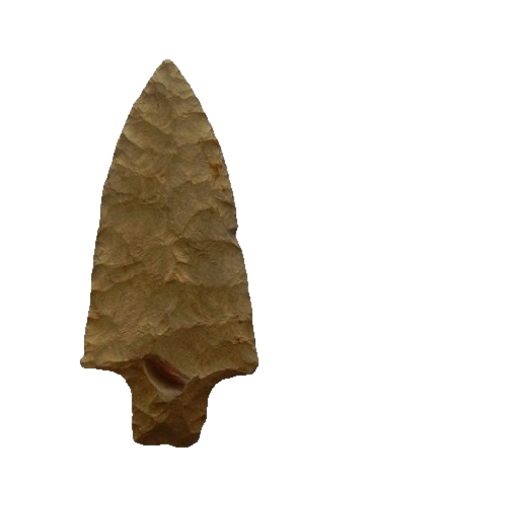
This substantial, triangular point features a stemmed design with an elliptical profile. Its blade exhibits a pronounced excurvate curvature, although some specimens may display a straighter configuration. The shoulders are generally characterized by a horizontal orientation, but can also be observed with a subtle upward incline, and may appear somewhat indistinct. The stem typically presents parallel sides, although slight variations in width, either converging or diverging, can occur. The basal edge ranges from straight to mildly concave and often displays evidence of light grinding. The flaking pattern is distinguished by the presence of expansive, well-executed scars that spread across both surfaces, complemented by finer pressure flaking along the edges, resulting in a random, intricate pattern.
Size
The dimensions of these arrowheads are characterized by the following measurements: length ranges from 45 to 115 mm, with smaller specimens potentially resulting from blade reduction due to re-sharpening. The width spans 25 to 60 mm, with a predominant range of 30 to 45 mm. The stem width varies between 15 and 28 mm, averaging between 20 and 25 mm. In terms of thickness, the arrowheads measure between 7 and 13 mm.
Distribution
This type is mainly discovered in New York, Pennsylvania, and throughout southern New England. It appears with decreased regularity in the remaining specified regions.
Additional information
More information needed.
Identified by
- Named by
- William A. Richie
- Year
- 1961
Similar types
Types that are easy to confuse with the Genesee point.
- Atlantic
- Heavy Duty
- Neville
- Newmanstown
- Piedmont
- Satchell
- Savannah River
Other types in the Genesee Cluster
- Koens Crispin
- Lehigh Eastern
- Snook Kill