
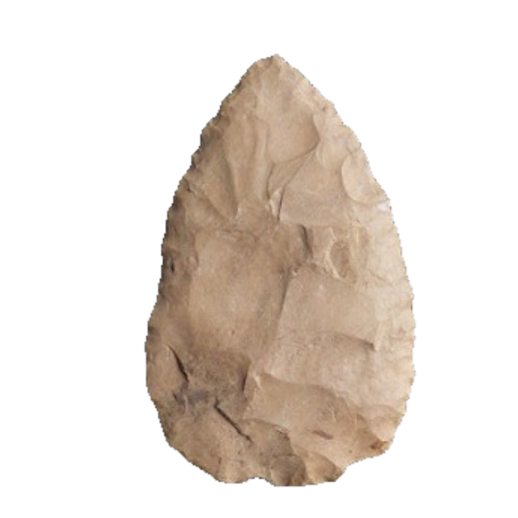
Arrowhead type
Adena Blade
Adena BladePreform Cluster3,500 - 1,300 B.P.Late Archaic to Woodland13 reference photos
Key facts
- Age
- 3,500 - 1,300 B.P.
- Cultural period
- Late Archaic to Woodland
- Culture
- Adena culture
- Size
- Medium to Large
- Shape
- Ovoid
- Material
- Shell
- Glacial period
- Neoglacial to Roman Warm
Description
This artifact exhibits a slender, ovoid silhouette with a medium to large size profile, characterized by a flattened cross-sectional morphology. The blade itself is distinguished by a pronounced excurvate curvature and a broad, expansive shape. The basal region is marked by a convex contour. In terms of flaking patterns, this point displays a non-directional, random arrangement of flakes. While evidence of percussion flaking is apparent, the preform is notable for its relative lack of refined pressure flaking, suggesting an unfinished or intermediate stage of manufacture.
Size
The dimensions of the arrowheads are characterized by a length range of 70 to 150 mm, with a typical average length of 80 to 90 mm. In terms of width, the measurements span from 35 to 55 mm, with an average width generally falling between 40 to 48 mm. The thickness of the arrowheads varies from 7 to 15 mm, with an average thickness of 9 mm.
Distribution
These artifacts are located within the Ohio River Valley region. The typical dispersion of the Adena points is highlighted in red (refer to Additional Comments). The yellow area represents the sphere of influence and exchange network of the Mound Builders, encompassing the Adena, Hopewell, and Mississippian Cultures.
Mainly found in
Also found, less often, in
Additional information
The Adena point, a distinctive arrowhead style, is predominantly associated with the Adena Culture, which flourished in the Ohio River Valley. This region served as the epicenter of Adena cultural activities, and it is likely that the Adena point originated here. Notably, similar point styles are found within the broader Mound Builder Distribution, including the Waubesa point, linked to the Hopewell culture, and the Dickson, Mason, and Florence points, which are characteristic of the Red Ocher Culture. When encountering Adena-style points outside their traditional cultural area, it is essential to consider the possibility that they may represent analogous types.
The chronological context of Adena points spans the late Archaic period to the early to middle Woodland period, as observed by Justice in 1987. Interestingly, early Adena points appear to have originated in the Tennessee River Valley, from which they disseminated during the early Woodland period, as suggested by Kneberg in 1956. The evolution of the Adena point is thought to have been influenced by the Cresap point, with variations of the latter giving rise to the Adena point over time. Perino's research has shed light on the manufacturing process, identifying preforms that were used to create both Adena and Cresap points, highlighting the technological and cultural continuity between these two point styles within the Adena Culture.
The study of Adena points offers valuable insights into the cultural dynamics and technological developments of the region during the late Archaic and early Woodland periods. By examining the distribution, morphology, and chronological context of these points, researchers can reconstruct the complex interactions and exchanges that occurred among prehistoric cultures in the Ohio River Valley and beyond. The Adena point, as a cultural and technological marker, provides a unique window into the lives and traditions of the Adena people, while also illuminating the broader cultural landscape of the region during this period.
Identified by
- Named by
- Gregory Perino
Similar types
Types that are easy to confuse with the Adena Blade point.
- Copena Round Base
- Karnak Blade
- North Bi-Face
- Red Ocher
- Tear Drop
- Tennessee River
Other types in the Preform Cluster
- Adena
- Adena Dickson
- Adena Narrow Stem
- Adena Robbins
- Adena Snapped Base
- Adena Vanishing Stem
- Adena Waubesa
- Cresap
- Fulton Turkeytail
- Gary
- Harrison Turkeytail
- Hebron Turkeytail