
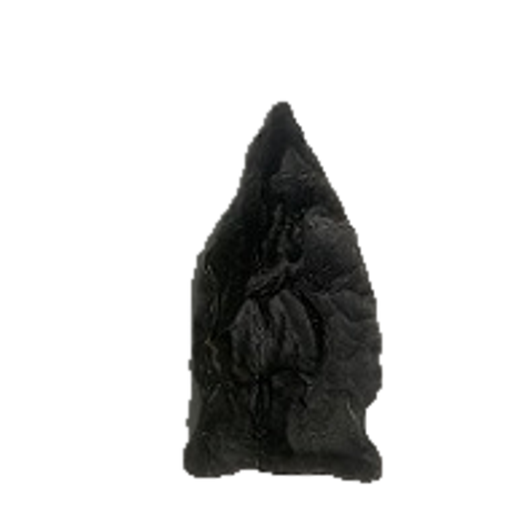
Arrowhead type
Brewerton Eared Point
Brewerton EaredMatanzas Cluster5,000 - 4,000 B.P.Middle Archaic14 reference photos
Key facts
- Age
- 5,000 - 4,000 B.P.
- Cultural period
- Middle Archaic
- Culture
- Brewerton Culture
- Size
- Small to Medium
- Shape
- Side Notch
- Material
- Jasper
- Glacial period
- Middle Holocene to Neoglacial
More from the Archaic period
Description
This triangular side notch point exhibits a compact to moderate size profile, characterized by an elliptical cross-sectional shape. The blade edge displays a varied curvature, transitioning from a straight alignment to a gently outward, excurvate sweep. The shoulders of the point are subtly defined, with faint, shallow auricles that impart a delicate appearance. The basal margin presents a range of configurations, from a straight line to a concave recess. The flaking pattern on this point is irregular and non-directional, lacking a discernible orientation or sequence, which is classified as a random flaking pattern.
Size
The dimensions of the arrowheads are characterized by a total length ranging from 19 to 63 mm, with a typical span of 27 to 38 mm. In terms of width, the measurement is 1.5 to 2 times the height, falling within a range of 19 to 29 mm. The thickness of the arrowheads varies from 5 to 9 mm, with an average thickness of 6 mm.
Distribution
The Brewerton Complex points are mainly concentrated in the northeast region and extend into the Ohio River basin. They have also been identified as far south as the Tennessee River Valley and the middle to lower sections of the Mississippi River valley, albeit less commonly
Additional information
The Brewerton Complex is a significant archaeological find, and one of its rarest and most intriguing points is the subject of ongoing scholarly debate. Geographically, this point is predominantly associated with the northeastern states and the Ohio River Valley, with relatively few discoveries reported in other regions. The origins of this variant have been explored by several researchers, including Richie (1971), who proposed that it evolved from the earlier Brewerton Side Notch point. However, Justice (1987) presented an alternative theory, suggesting that this point is more likely an extension of the Eared Triangle form rather than a direct development from the Side Notch point.
A closer examination of the characteristics of these points reveals some notable differences. When comparing examples of the Eared Triangle and the Brewerton Complex point with similar lengths, it becomes apparent that the Eared Triangle variation tends to be wider and thinner. This observation has led Justice to propose that the Brewerton Complex point may, in fact, be a re-sharpened version of the Eared Triangle. This hypothesis highlights the complexities of archaeological classification and the need for careful analysis of morphological characteristics. By studying the nuances of these points, researchers can gain a deeper understanding of the technological and cultural developments of the societies that created them.
The study of the Brewerton Complex point and its relationships to other archaeological forms, such as the Eared Triangle and the Side Notch point, offers valuable insights into the lives and traditions of Native American communities in the northeastern states and the Ohio River Valley. Through continued research and analysis, archaeologists can refine their understanding of the cultural and historical contexts in which these points were created and used, ultimately shedding more light on the rich and diverse heritage of Native American cultures. By examining the characteristics and distribution of these points, researchers can reconstruct the technological, social, and economic dynamics of these ancient societies, providing a more comprehensive and nuanced understanding of their place in American history.
Identified by
- Named by
- William Richie
- Year
- 1961
- Type site
- Robinson Site, Onondaga County, New York
Similar types
Types that are easy to confuse with the Brewerton Eared point.
- Kittatinny
- Rowan
- Steubenville
- Fox Creek
- Yadkin Eared
Other types in the Matanzas Cluster
- Brewerton Corner Notch
- Brewerton Side Notch
- Matanzas