
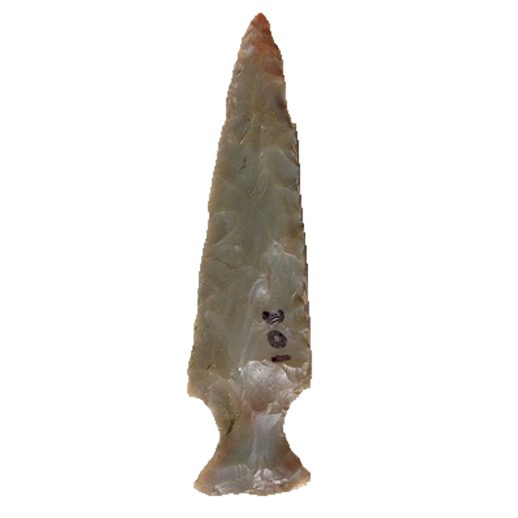
Arrowhead type
Fishspear Point
Fishspear1,500 - 1,300 B.P.Late Woodland13 reference photos
Key facts
- Age
- 1,500 - 1,300 B.P.
- Cultural period
- Late Woodland
- Size
- Medium to Large
- Shape
- Expanding Stem to Side Notch
- Glacial period
- Roman Warm to Vandal Minimum
More from the Woodland period
Description
This lanceolate point exhibits a distinctive morphology, characterized by a medium-sized blade with an elliptical profile. The blade's curvature is pronounced, with an excurvate shape that tapers inward at the tip, while the edges converge to form parallel margins before recurving toward the base. The shoulders are angled upward, creating a pronounced delineation between the blade and the stem. The stem itself is expanding, with a base that transitions from a convex to a straight edge. The flaking pattern observed on this point is random, lacking a discernible pattern or orientation.
Size
The arrowheads exhibit a range of dimensions, with overall lengths spanning 45 to 95 mm. The stem section measures between 11 and 20 mm in length. In terms of width, the blade ranges from 11 to 23 mm, while the neck varies from 9 to 13 mm. Additionally, the stem width is recorded as falling within the 10 to 22 mm range.
Distribution
This type is mainly located in the central Ohio River Valley and extends into the Tennessee River Valley. It can also be discovered in the Blue Ridge area of Virginia and North Carolina, albeit less commonly.
Mainly found in
Also found, less often, in
Additional information
More information needed.
Identified by
- Named by
- John W. Schatz
- Year
- 1959
Similar types
Types that are easy to confuse with the Fishspear point.